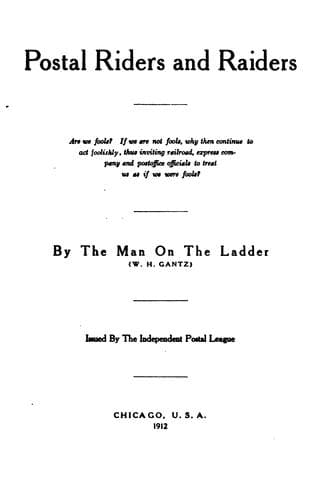
Postal service -- United States -- Second-class matter
But that is not all. The strong weeklies and monthlies are not going
to be put out of business by legislation of that rider character. They
will continue in business. They will meet its unjust exactions by
readjustments. They are printing on sixty to eighty pound stock. Some
parts of their periodicals are printed on even heavier stock. They will
go to the paper mills and demand _lighter_ stock, of special finish--_and
their demands will be met_--and fifty to sixty pound stock will be used.
The special finish will give the reader just as presentable a magazine,
typographically, as he now receives.
But you observe that the _publisher_ will be saving from twenty to fifty
per cent in _stock weight_.
You will also observe that the paper mills will be using twenty to fifty
per cent less wood pulp than they are now using.
You will also observe that the railroads will haul twenty to fifty per
cent less of pulp timber and less wood-pulp paper than they now haul.
“Only a few magazine publishers will be affected,” eh?
Let us “recast” as far as we have gone.
The owners of pulp wood acres or stumpage would be affected, would they
not? There are probably three to five hundred of them in the country,
taken at a low estimate.
They are not of the “few magazine publishers” are they?
Pulp mill and other investors in pulp-wood stumpage seldom buy until
they have an estimate by some skilled judge as to the probable “cut”
the acreage will yield. For this purpose the prospective purchasers
usually employ one or more “timber cruisers.” A timber cruiser is a man
so skilled and experienced that he can look at a standing tree and tell
you within a hundred feet or so how much lumber it will saw or how many
cords of pulp or other wood it will cut. He “steps off” an acre, sizes
up the available trees growing on the acre, averaging up the large trees
with the small ones, and then estimates or calculates the _average_ wood
or lumber growth on that acre. He then goes off to some other acre.
The latter may be only a few hundred yards or it may be a mile or two
from the acres last measured, the estimate on which the “cruiser” has
carefully noted in his “field book.”
The second acre he “works” as he did the first, and so the “cruiser” goes
on with acre after acre through a forest of ten, fifty, a hundred, or it
may be a million or more acres of “stumpage,” always careful to note the
“light” and the “heavy” timbered sections, and marks with a sharp, shrewd
and experienced eye an estimate of the number of acres covered by the
light and the heavy growth of timber. When he has covered the acreage his
employer contemplates buying, he comes back to civilization, turns in his
field book and makes a report to the boss. On that showing the boss buys
or declines.
Public-domain text, read in full here on John Shaqi.
Reviews
Reviews
No reviews yet
Be the first to share your thoughts on this work.
Elsewhere in the archive
Join the Discussion
Join the discussion
Sign in to leave a comment or review.
Sign InorCreate an account