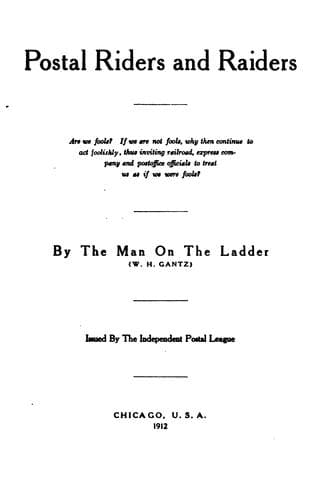
Postal service -- United States -- Second-class matter
Sometimes, of course, the careful, prudent boss may have two, three or
a dozen cruisers, covering different fields of a vast forest section
and, sometimes, virtually _trailing_ each other. In the latter case, the
buyer seeks to use one cruiser’s estimate as a check on the other. In any
event, however, the purchase or investment is usually made on the showing
the cruisers have made.
Now, this talk about timber, cruisers, etc., may be uninteresting to the
reader. I sincerely hope, though, he will read it and follow me along
the same lines a little further. My object is to show how wide of the
truth--how unjustly or ignorantly wide of the truth--Mr. Hitchcock was
when making the statement, which it has been repeatedly and reputably
asserted he did make, to the effect that the legislation he sought
would “affect only a few magazine publishers.” I have stated, and have
given what I believe to be sound, valid reasons in support of the
statement, that legislation of the nature, covered by his rider amendment
ultimately--_and necessarily_--must be either annulled by the courts or
be so broadened as to remove its special or class features. Of course,
Mr. Hitchcock wanted--_and he still wants_--legislation of the nature
indicated in that rider to become _operative law_. It is my belief he
entertained such hope and desire when he asserted that an enactment of
the character of his rider would “affect only a few magazine publishers.”
At any rate, it was with such belief I introduced this division of our
general subject.
As previously stated, legislation of the character sought by Mr.
Hitchcock cannot be enacted into operative law _without cutting down the
consumption of wood pulp from thirty to fifty per cent_.
Such a cut in consumption, I am here trying to show, cannot be made
without affecting the earnings and lives of men--many thousands of men
and families--who cannot even be imagined as of those “few magazine
publishers.”
When the stumpage owner decides to cut five, ten, fifty, a hundred or
more thousand acres for milling, another gang of men--“road blazers”--is
sent into the forest. If the transportation is to be by water, some
river or smaller stream, these latter men select suitable roll-ways and
boom yardages along the stream. From each of these they “blaze” or mark
the trees and smaller growths to be felled and the obstructions to be
removed in order to provide a haulage roadway--usually providing for both
wagons and snow sleds or sledges. If the transportation is to be by rail,
corresponding work is done, the roadways branching in from the forest to
the rail sidings where the loading is to be done. Not infrequently “spur
tracks” are blazed which sometimes run for miles into the forest away
from the main line of the railway.
Public-domain text, read in full here on John Shaqi.
Reviews
Reviews
No reviews yet
Be the first to share your thoughts on this work.
Elsewhere in the archive
Join the Discussion
Join the discussion
Sign in to leave a comment or review.
Sign InorCreate an account