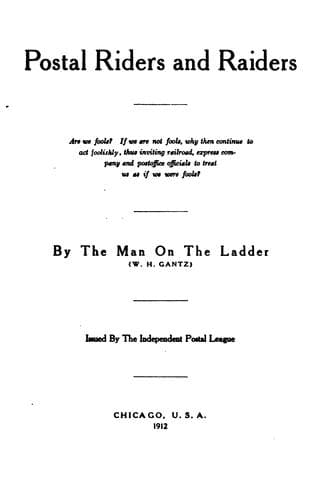
Postal service -- United States -- Second-class matter
I have previously intimated that Mr. Hitchcock is still devoting
himself to forcing his _ulterior_ motive into operation, either as law
or department ruling. In evidence of this I shall here quote from his
address or addresses before the Hughes Commission. This Commission was
created in the closing hours of the last session of Congress--created as
a sort of cushion or pad in order that his _unconstitutional_ “rider”
might take its cropper without breaking any bones or painfully lacerating
the _official_ feelings of Mr. Hitchcock. This Hughes Commission convened
in New York City, August 1, 1911. Following is Mr. Hitchcock’s opening
address before it, as reported by the New York Times, August 2. The
italics are the writers:--
Postmaster General Hitchcock opened for the department. He said
his study of the postage rate problem had led him to believe
that certain fundamental principles of administration, almost
new to the Postoffice Department at present, should be closely
adhered to. These included _the operation of the service on a
self-supporting basis_, maintained by imposing such charges as
would yield an income equal to the expenses. They included, also,
he said, such an adjustment of the postage charges _as would
make each class of mail matter pay for its own handling, and no
more_. He would further have the levying of postage rates made on
the basis of _the average cost of handling and carriage for the
country as a whole_, and, finally, postal laws should be enacted
so definite in character as to be easy of interpretation and
susceptible of uniform enforcement.
Mr. Hitchcock stated in this connection that when the books for
the fiscal year of 1911 are closed _they will show for the first
time in many years a surplus of postal funds_, and he hoped that
this condition would become permanent. Mr. Hitchcock opposed
any new classification of mail matter at this time, saying the
present classification could be made to include all matter
now admissible, and he doubted the expediency of attempting
a revision. He then sought to set forth the large share
second-class matter has in the burdens of the department, and the
_small percentage it pays of the total cost or even of its own
cost_.
“During 1910,” he said, “there were carried in the mail
8,310,164,623 pieces of first-class mail, consisting of letters,
other sealed matter, and postal cards. This mail averaged in
weight 0.35 of an ounce a piece, making 45.1 pieces to the
pound. The cost of handling and carriage for this mail was
$86,792,511.35, an _average of 47 cents a pound_, while the
postage charge was $154,796,668.08, leaving a clear profit of
$68,004,156.73.
Public-domain text, read in full here on John Shaqi.
Reviews
Reviews
No reviews yet
Be the first to share your thoughts on this work.
Elsewhere in the archive
Join the Discussion
Join the discussion
Sign in to leave a comment or review.
Sign InorCreate an account