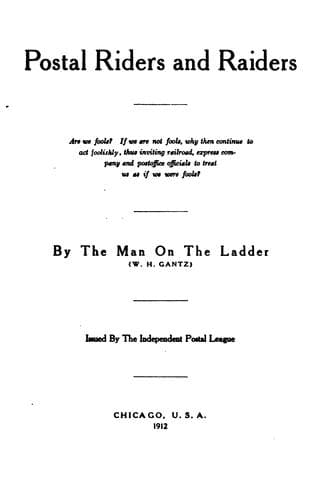
Postal service -- United States -- Second-class matter
“During the same year there were carried 4,336,259,864 pieces
of second-class matter, newspapers and other periodical
publications, averaging 3.33 ounces a piece, or 4.8 pieces to the
pound. The cost of handling and carriage was $80,791,615.03, or a
_little less than 9 cents a pound_, while the postage return was
only $10,607,271.02, leaving a _total loss of_ $70,184,344.01.
“From a review of the rates provided for the several classes
of mail, it will be observed that in comparison with the
cent-a-pound charge for second-class matter the rate on
third-class matter is 700 per cent. higher; that on fourth-class
matter 1,500 per cent. higher, and that on letter and other
first-class matter 3,100 per cent. higher. While it is true
that _the expense of handling and carrying second-class mail is
less than for any other class_, due to the size and weight of
single pieces, to relief from the cancellation of stamps, and
to the fact that a considerable part of the bagging, sorting,
and labeling in the offices of origin is done by the publishers,
nevertheless a charge of 1 cent a pound covers but a small
fraction of the actual cost.[6]
“The present self-supporting condition of the service is
made possible only by the fact that other classes of mail,
_particularly the first-class, are excessively taxed to make up
the loss caused by the inadequate charge on the second-class_.
This will be better understood when it is noted that although
first-class matter comprised during the fiscal year 1910 only
13.4 per cent. of all the revenue-producing domestic mail, it
yielded a net profit of $68,004,156.73, while second-class
matter, comprising 65.6 per cent. of all the revenue-producing
domestic mail, yielded but $10,607,271.02, leaving the tremendous
loss of $70,184,344.01. Thus the deficit caused by the heavy loss
on the handling and carriage of second-class matter was greater
than the profit obtained from first-class matter.”
Mr. Hitchcock here made a plea for equalization of the rate on
second-class matter on the ground that it would at once make
possible the reduction of letter postage from 2 cents to 1 cent
an ounce. This reduction would come about from the fact, he
said, that the present profit in handling first-class matter was
approximately equal to the loss sustained in the transportation
of second-class mail.
Mr. Hitchcock said, however, that he did not believe that the
rate for second-class mail should be at once advanced to where
_it would cover the cost of handling and carriage, although that
should be the ultimate end in view_.
Public-domain text, read in full here on John Shaqi.
Reviews
Reviews
No reviews yet
Be the first to share your thoughts on this work.
Elsewhere in the archive
Join the Discussion
Join the discussion
Sign in to leave a comment or review.
Sign InorCreate an account