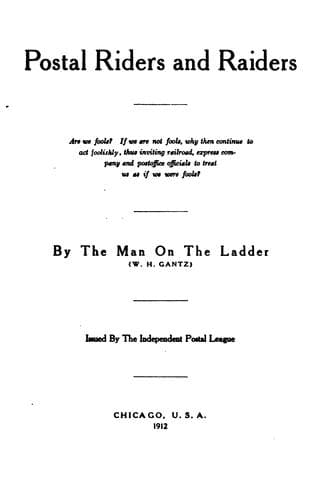
Postal service -- United States -- Second-class matter
One of the strongest arguments of the hearings, because of the
experience which he has had as a postal official, was made by Mr.
W. S. Shallenberger, who had served several years in Congress
as a member of the Committee on Postoffice and Postroads.
Mr. Shallenberger was for a number of years Second Assistant
Postmaster General, and now represents the Interdenominational
Publishers who issue Sunday school literature throughout the
United States. This witness gave it as his opinion that an
increase in the rate on second-class matter would cause magazines
and newspapers to avail themselves of the facilities now offered
by the express companies which are becoming active competitors
of the government in transporting second-class matter, these
corporations obtaining better rates from the railroads than is
given to the government. Mr. Shallenberger expressed the view
that since every civilized nation was cheapening the cost of
postal service the fact that our country was seeking to increase
the rate seemed to be reactionary.
Mr. Shallenberger served under six Postmaster Generals and all of
these held that the government was carrying second-class matter
at a loss. But his opinion was that there was a substantial
profit in the present rate, at the same time condemning the idea
that each particular schedule should be made to pay its own way,
the stimulus toward encouraging other schedule receipts not being
given its proper consideration. Mr. Shallenberger gave a hint
concerning hidden influences seeking to have the second-class
rate increased but did not enter deeply into this phase of the
subject. The controversy between Mr. Shallenberger and Second
Assistant Stewart was animated and prolonged, and touched on
features connected with the compensation paid railroads for
hauling the mail, the express companies getting better terms than
the government, this statement being made by a representative of
the Postal Progress League.
The strongest point the publishing interests made was when the
superintendent of the railway mail service, Chas. H. McBride,
testified that a considerable part of the estimate upon which the
department’s figures are based is guesswork and assumption, he
admitting that if this were so the result would not be greatly
different from what the officials first claimed. On the whole
Superintendent McBride’s testimony was calculated to show that
the Postoffice Department was desirous of making out a case
against the second-class schedule, however necessary it was to
twist figures and conceal facts in order to do so.
Public-domain text, read in full here on John Shaqi.
Reviews
Reviews
No reviews yet
Be the first to share your thoughts on this work.
Elsewhere in the archive
Join the Discussion
Join the discussion
Sign in to leave a comment or review.
Sign InorCreate an account