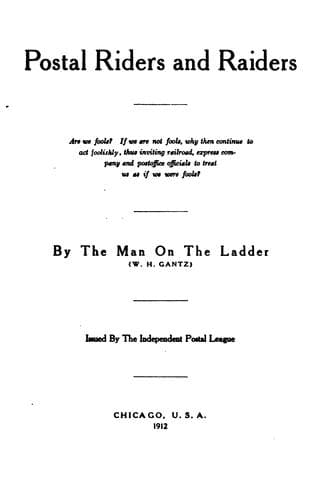
Postal service -- United States -- Second-class matter
This declaration was looked upon as an argument by the magazine
publishers as favoring their contention that the advertising
portions of their periodicals are justified by legitimate
business reasons, as an increased volume of advertising enables
publishers to issue periodicals of much higher literary
excellence. The postal authorities held with firmness to the
conviction that advertising matter in publications is primarily
for the advantage of the publisher, and therefore should be
charged a higher rate than reading matter. Postmaster General
Hitchcock went on record before the commission as declaring
that he would recommend to Congress an increase on the
advertising portion of magazines and newspapers of a cent a
pound additional. Assuming that the postoffice officials are
prompted by a legitimate purpose in their desire to increase
rates on second-class matter, their arguments before the
commission have been transparently weak, and an unbiased mind
they would fail in convincing, but the feeling is that the
commission will accept the conclusions of the postal authorities
that the government rate of one cent a pound is inadequate for
transporting second-class matter. To justify the position taken
by the government that each schedule should maintain itself,
the Postmaster General intends to press with vigor a reduction
of first-class postage from two-cents to one cent a letter, he
citing the profit on first-class mail and the alleged loss on
second-class matter as his reason for the change of rate.
Religious and denominational publications were represented
before the commission, the contention being made by these
that the doubling of the rate on second-class matter would
work very serious injury to the religious press, forcing many
publications out of business. This statement was made by E. R.
Graham, representing the Methodist Book Concern publications in
Cincinnati and New York, and seemingly it made an impression on
the members of the commission. The attorneys representing the
publishers were much interested in Mr. Graham’s statement, he
being considered a competent authority on the matter.
Public-domain text, read in full here on John Shaqi.
Reviews
Reviews
No reviews yet
Be the first to share your thoughts on this work.
Elsewhere in the archive
Join the Discussion
Join the discussion
Sign in to leave a comment or review.
Sign InorCreate an account