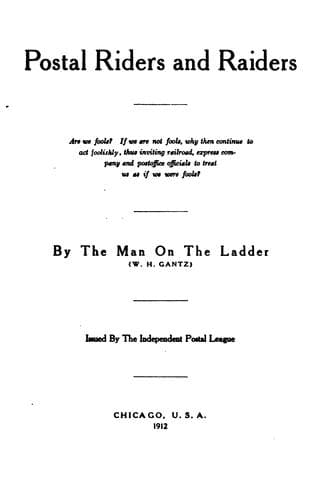
Postal service -- United States -- Second-class matter
A glance at the tabulation made of this item shows a huge jump in its
amount for the year 1910 of $6,200,000, round figures. Next, it appears
that the necessities of business, _or the emergency needs of those
building the report_, forced this item still upward in the showing for
1911 as made December last--upward by $345,718.12, making its total
$7,132,112.23. In the report before me, no analysis of that large
carried-over payment on account of prior years is given. The Third
Assistant Postmaster General may furnish information as to the year or
years of its origin. His report has not reached me yet, so I cannot say.
The bald statement is there, however, that 1911 _paid over seven million
dollars_ on account of 1910 and prior bills. It is also in evidence that
_no information whatever_ is published which enlightens the public as
to the amount of _unpaid 1911 bills that are carried forward to 1912
account_.
Whether adverse criticism is justifiable or not, such cloaking of
accounts in giving them publicity most certainly warrants it. It is just
this cloaking that has subjected Mr. Hitchcock’s little vest-pocket
surplus for 1911 to much and merited criticism, doubt and question.
Mr. Urban A. Waters, in testifying before the House Committee on Civil
Service Reform _harpooned_ the Postoffice Department with an accusation
that it had permitted a million dollars to waste, evaporate, be
misapplied or stolen, in connection with a deal for sanitary and safety
appliances to railway mail cars.
If Mr. Waters’ charges are grounded in fact, then is provoked and
_invited_ the question: Is it designed or intended to carry that million
into the accounting of 1912--or into that of some future year--as an
“Expenditure on account of previous years?”
Mr. Waters is publisher of the Denver Harpoon. He can say things and is
generally recognized as a man who makes a practice of gathering the facts
to back up what he says before he says it. In his testimony, so far as
I know, Mr. Waters made no statement or suggestion that the evaporated
million he spoke of would be, or could be, very securely _cacheted_
or “fenced” in this “account of previous years.” It is The Man on the
Ladder who points out--who says--that such loose accounting as carries
to account of a subsequent year the expenditures made or incurred in a
previous year can _very readily_ be made to cloak a steal of one or more
millions of dollars.
Public-domain text, read in full here on John Shaqi.
Reviews
Reviews
No reviews yet
Be the first to share your thoughts on this work.
Elsewhere in the archive
Join the Discussion
Join the discussion
Sign in to leave a comment or review.
Sign InorCreate an account