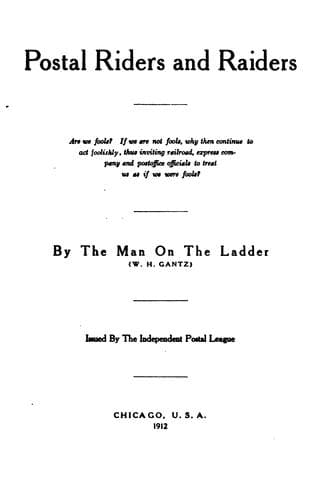
Postal service -- United States -- Second-class matter
Foolish question? Yes, it ought to be--but it isn’t. The whole
express business rests upon the answer to this question. When the
law was enacted, _there was no doubt_ about the meaning of the
word packet, because there were no express companies to raise the
question, and everybody knew that packet was a synonym, used more
frequently then than now, for “parcel.” Express companies did not
come along to raise the question until forty years ago.
Even the express companies, when they began business, had no
doubt about the meaning of the word “packet.” This is proved
by the fact that whenever they handled packets, they required
shippers to affix postage stamps. But recognition of the
government’s mail monopoly had a strong tendency to curtail
express business, and there came a time when the express
companies decided to evade the law, leave off the stamps and
openly compete with the government.
See how ridiculous the express companies have since made your
government. In 1883, a mail carrier who had stolen tea from a
packet, made the defense at his trial that since a packet of
tea was neither a letter nor a parcel, the law which prohibited
tampering with sealed letters or parcels could not be invoked
against him. United States Judge McCreary, who sat in the case,
was not so minded. He told the jury to disregard the prisoner’s
defense. In other words, a package was not only a parcel, but
presumably a packet. The judge split no hairs about definitions.
The mail carrier had stolen tea. That was enough. He was sent to
prison.
See how another judge, years later, construed “packet.” Nathan
B. Williams, of Fayetteville, Ark., brought suit in the
United States Circuit Court to prevent express companies from
carrying packets. When the last judge had had his guess about
the conundrum, Mr. Williams was judicially informed that the
government mail monopoly, so far as packets are concerned,
extends only to “packets _of letters_.” In other words, a packet
is a packet of letters; that and nothing more. Here are the
judge’s words:
“While Congress has full constitutional powers to reserve to
the postal department a monopoly of the business of receiving,
transporting and delivering mails, and, in the exercise of such
rights, may enact such laws, regulations and rules as will
effectively preserve its monopoly, yet this monopoly is intended
(see the Judge read the mind of the Congress of 1845), to extend
only to letters, packets of letters, and the like mailable
matter, and Congress has never attempted to extend this monopoly
to the transportation of merchandise in parcels weighing less
than four pounds, nor to prohibit express companies from making
regular trips over established post routes, or from engaging in
the business of carrying such parcels for hire.”
Public-domain text, read in full here on John Shaqi.
Reviews
Reviews
No reviews yet
Be the first to share your thoughts on this work.
Elsewhere in the archive
Join the Discussion
Join the discussion
Sign in to leave a comment or review.
Sign InorCreate an account