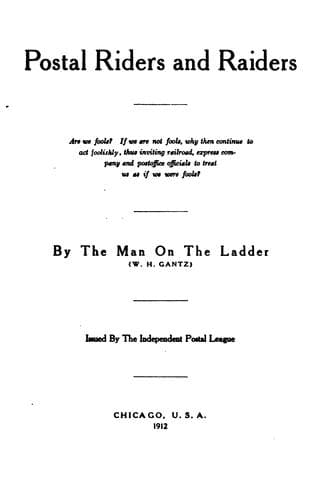
Postal service -- United States -- Second-class matter
Six companies control more than 90% of the country’s express
business, and of these the Adams is one of the oldest and most
powerful. Organized more than fifty-six years ago, its capital
stock had grown to $10,000,000 by 1866, in which year the members
of the association, as the shareholders are called, received a
stock dividend of $2,000,000. The $10,000,000 of stock itself did
not represent shares issued for cash. According to the company’s
own reports, no shares were ever issued for cash. The 100,000
shares were given to members of the association to represent each
member’s pro rata ownership in the assets which had accumulated
from earnings. As late as 1890, according to the census figures,
the company had an actual investment in property employed in its
business of but $1,128,195. Yet it had been paying 8% dividends
for many years, or 80% on the actual value of the property in
use. In 1898 it distributed $12,000,000 of its own bonds to
stockholders, these bonds to be secured by the deposit in trust
of the surplus funds not used in the express business. At this
time the company reduced its dividend rate to 4%, but as 4% was
also paid on the bonds, the stockholders did not suffer any loss
of income. By 1904 the dividend rate had mounted to 10%, the
bond interest remaining at 4%. In 1907, $24,000,000 additional
bonds were given to the stockholders, likewise secured by another
fat surplus, and like the first issue, paying 4% in interest.
Dividends on the stock have since been maintained at 12% and
there has grown up another surplus of nearly $25,000,000 which
must soon be disbursed. Meanwhile the property actually employed
for express purposes has grown to but something more than
$6,000,000.
Moreover, there is another large fund slowly but surely
accumulating in connection with the 1907 bond distribution. This
1907 gift to the shareholders was in the form of a bond issue
secured by the deposit of stocks and bonds of other corporations
formerly owned by the company itself. The deed of trust provides
that if the income from these stocks and bonds is more than
enough to pay interest of 4% a year on the $24,000,000 of Adams
Express bonds, the surplus shall accrue and be distributed in
1947 among the holders of the Adams Express bonds. As a matter
of fact there is a computed excess income derived in this way
of $151,517.50 a year and by 1947 this will have mounted up to
more than $6,000,000, not allowing for compound interest. Here is
a 50% extra dividend being nourished along toward maturity. If
there is any better example of being able to eat one’s cake and
have it too, I have yet to hear of it.
Public-domain text, read in full here on John Shaqi.
Reviews
Reviews
No reviews yet
Be the first to share your thoughts on this work.
Elsewhere in the archive
Join the Discussion
Join the discussion
Sign in to leave a comment or review.
Sign InorCreate an account