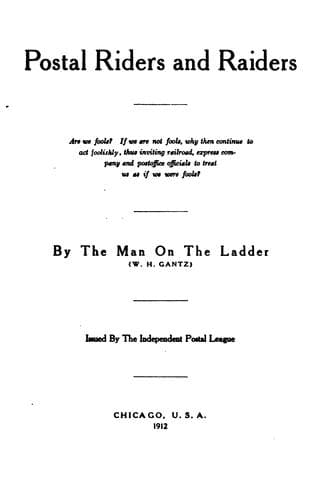
Postal service -- United States -- Second-class matter
At the outbreak of the civil war the Adams Express Company turned
its routes in the Southern States, in which it had enjoyed a
complete monopoly, over to the Adams-_Southern_ Express Company,
_created by the Georgia courts for the purpose of assuming this
business_. The property of the association was to be represented
by 5,000 shares, of which 558 were then issued. The Adams Express
Company has held to the present day a dominant interest in this
association, which it created to facilitate business _during the
war_. After hostilities ceased, it resumed some of its Southern
routes by agreement with the Adams-_Southern_ Express Company,
whose name had meanwhile been changed to the _Southern Express
Co._ The two companies still work in common and use the same
wagons and offices in many places.
But close as the Southern Express is to its parent company, it
has a separate enough existence to justify a separate account
of its _money-making capabilities_. Referring to the original
558 shares of stock, the secretary and treasurer of the Southern
Express says: “_None of the original twenty-four stockholders
are living and there is no existing record to show how much was
realized from the distribution._” This does not help us much,
but in another report to the Interstate Commerce Commission
the company appears to know what these records showed, for it
says “_none of its stock was ever issued for real property_,
equipment, acquisition of securities, or for any other purpose
in the sense in which the issuance of stock is understood in
connection with corporations.” But we do find that in 1866 the
number of shares was increased to 30,000 and distributed to the
owners _as a stock dividend_. Plainly, the civil war did not
impoverish the express carriers. Then in 1886 enough more new
stock was created to give the owners five shares in place of
every three which they already held, so that there are now 50,000
shares.
Five hundred and fifty-eight shares of stock, the circumstances
of whose issue are known to no one living, have sprouted into
50,000 shares by the mere process of _paying stock dividends_.
Dividends of 8%, or $400,000 a year, are now paid upon the 50,000
shares, although the entire value of the company’s property, real
estate, buildings, equipment, furniture, etc., was only $944,179
_on June 30, 1909_. Here are dividends of 8% on $5,000,000 stock,
or more than 40% on the value of the property employed in the
business. And this is not all. The Southern Express Company owns
high-grade stocks and bonds valued at almost $4,000,000, which
may some fine day form the basis of another melon.
Public-domain text, read in full here on John Shaqi.
Reviews
Reviews
No reviews yet
Be the first to share your thoughts on this work.
Elsewhere in the archive
Join the Discussion
Join the discussion
Sign in to leave a comment or review.
Sign InorCreate an account