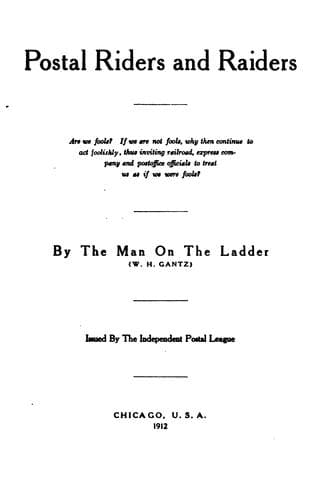
Postal service -- United States -- Second-class matter
“For the purpose of emphasizing the importance of loading as
essential to the determination of railway mail compensation, as
well as to suggest the line of desired improvement in the present
railway mail service, it may be added that were it possible to
load 5 tons in a car, the expense would be reduced to $1,766 per
mile of line; that is to say, a sum less than one-half the amount
actually paid.”
Dr. Adams in the foregoing was presenting a judgmental summary,
or digest, of the testimony before the Wolcott Commission on this
“railway-mail-pay” question. His opinion, or conclusion, as to the
dominant factors involved, has been recognized as authority--_if not
final authority_--on the points to which he spoke.
Now, let us figure a little more. I’m not much at “ciferin.” Maybe the
reader can help me along. Let’s get properly started.
Those rail “postoffice cars,” of which Dr. Adams spoke, are from 40 to 55
feet or more in length. They must weigh, empty, or “stripped,” figuring
running trucks, body, etc., _forty to one-hundred or more thousand
pounds_. So, according to Dr. Adams, this twenty to fifty ton vehicle is
sent hurtling over a hundred or a five-hundred mile run on a steel track
with finest and most modern engine or motive power, baggage and express
cars ahead, and sleepers, buffet, diner and observation cars trailing,
_to carry two tons of United States mail_ in each mail car in the train.
Oh yes, I know that Dr. Adams spoke some years ago (1901, I believe), and
spoke of the “average load” of mail carried by mail cars then. I also
know that our present Postmaster General has “gone after” this railway
mail car raiding--has made them carry more load. All praise to him for
doing so. It was an action which _any_ of his predecessors had the power
to have taken, and which should save millions of postal revenues.
The department report for 1910 (P157), states, there were 1,114 full
and 3,208 apartment postal cars in service--_rented_ cars--while there
were 206 of the former and 559 of the latter (a total of 765), kept
in “reserve.” That makes a total of 5,087 postal cars for which the
government pays rent.
There is, however, another strong presumption--with some very robust
facts which investigation has uncovered--that a considerable number
of the so-called “reserve” cars are in the hospitals about railroad
shops, where such patients receive little but “open air treatment.” In
“emergencies” it is legitimate, of course, to presume that the division
traffic manager may order out or put on the rails any of these hospital
cars, “full” or “apartment,” as first aids to the injured. And it is
right that he does so.
But why, in the name of George Washington, should all these hospital cars
be charged up to the Postoffice Department? Yes, why?
Public-domain text, read in full here on John Shaqi.
Reviews
Reviews
No reviews yet
Be the first to share your thoughts on this work.
Elsewhere in the archive
Join the Discussion
Join the discussion
Sign in to leave a comment or review.
Sign InorCreate an account