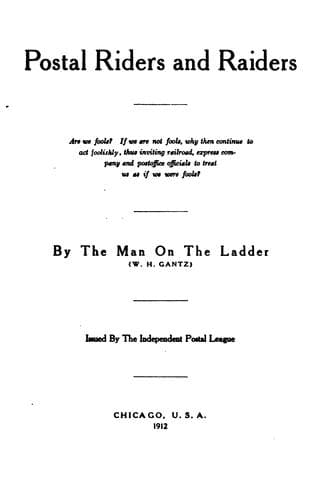
Postal service -- United States -- Second-class matter
At any rate, he came to his present official job, it appears from most
dependable information, with a “deficit”--the postal service deficit, of
course--in his mind, and he immediately began in his vigorous, though
somewhat peculiar, way to work it off. Whether his dominating intent
was to work that deficit off the department books or merely work it off
his mind, has not thus far appeared, save, of course, to the coterie in
the circle of Mr. Hitchcock’s intimates and a somewhat numerous body of
periodical and newspaper reporters on the job in Washington.
The latter, of course, know everything. And what they don’t know they go
to all extremes to find out. It was, therefore, a hopeless attempt of
Mr. Hitchcock’s (though he yet seems scarcely able to understand how so
much information got to the public), to keep his _scheme_ to remove the
Postoffice Department’s deficit by shunting the _whole of it onto some
twenty or thirty periodicals_--it was, I say, a hopeless task for him to
keep that scheme safely within the periphery of the corral where herded
the “influenced” and the “influencing.”
But why go on? Mr. Blythe in his article tells some things I want to say
and he says them so much better than I can tell them that I will give
the reader the benefit of that difference and quote him on a number of
points. As showing the studied attempt at snap legislation in the very
closing hours of Congress, Mr. Blythe says:
The Sixty-first Congress expired by constitutional limitation
at noon on March 4th, last. On Friday afternoon, March 3, the
postoffice appropriation bill was up for consideration in the
Senate. It was being read for committee amendments. At half past
4 page 21 of the bill was reached, and with it the amendment
proposed by the Senate Committee on Postoffices and Postroads to
increase the rate of second-class postage in certain specified
cases and in certain contingencies. Second-class postage is the
postage paid by newspapers, magazines and periodicals.
There had been several speeches. Senator Carter spoke for the
amendment, and Senators Bristow, Cummins and Owen against it.
Senator Jones, of Washington, had a few observations in favor of
the amendment also. At 5 o’clock Senator Boies Penrose, Chairman
of the Senate Committee on Postoffices and Postroads and in
charge of the bill, rose in his place, withdrew the amendment
increasing second-class postage, and submitted in its stead an
amendment providing for a commission to investigate the question
of fact concerning the cost to the Postoffice Department for
transportation of second-class mail matter. This amendment was
unanimously adopted and the Senate proceeded to the consideration
of other sections of the bill.
Public-domain text, read in full here on John Shaqi.
Reviews
Reviews
No reviews yet
Be the first to share your thoughts on this work.
Join the Discussion
Join the discussion
Sign in to leave a comment or review.
Sign InorCreate an account