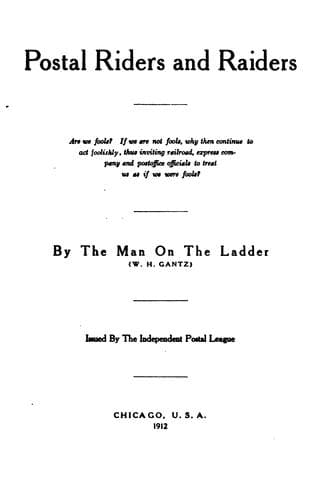
Postal service -- United States -- Second-class matter
Please notice that railroad companies--not railroad men,
railroad companies--own more than $20,000,000 of stock in
express companies. The express companies are capitalized at only
$48,000,000. Railroad companies therefore own almost half of the
stock of the express companies. Railroad men like Mr. Gould, the
Vanderbilts and Mr. Morgan also own stock in express companies.
Railroad men presumably do not vote their private holdings of
express stock in opposition to the manner in which they vote the
express stock owned by the railways they control. But, even if
railway men owned no express stock, the ownership by railways of
a solid block of more than $20,000,000 of express stock would
enable the railways to control the express companies. Mr. Morgan
controls many corporations in which he holds only a minority
interest. It is the way of big men to control more than they own.
…
Let us assume that you attach no significance to the ownership
by the railways of almost half of the stock of the express
companies. You don’t believe the railroads would take the trouble
to get control of $3,500,000 more stock and thus control the
companies. You want to be shown.
All right. You don’t mind using your common sense? Good.
Wouldn’t railroad companies be incorporated fools if they didn’t
control the express companies? Couldn’t the railroad companies,
if they cared to, control the express companies, even though
the railroad companies owned not a share of stock in any of the
express companies? What is an express company?
An express company is a corporation that is engaged in
transportation. Not a single express company owns a foot of
railway track, a locomotive, a roundhouse or a water tank. Not a
single express company employs an engineer, a fireman, a train
dispatcher, or a section hand. Not a single express company could
carry a bar of soap from New York to Albany without using all
of the mentioned instruments of transportation, besides many
others. In other words, an express company is an institution
engaged in transportation without owning any of the means of
transportation. It exists only by sufferance. So long as railroad
companies are willing to haul the cars of an express company,
the express company may do business--but no longer. An express
company, if ill-treated, has no other place to go. It cannot hire
a department store company to haul its cars, nor a dry-goods
firm, nor a manufacturer of hats. An express company must go to
railroads for its transportation facilities, accept the best
terms it can get, or go out of business.
Public-domain text, read in full here on John Shaqi.
Reviews
Reviews
No reviews yet
Be the first to share your thoughts on this work.
Elsewhere in the archive
Join the Discussion
Join the discussion
Sign in to leave a comment or review.
Sign InorCreate an account