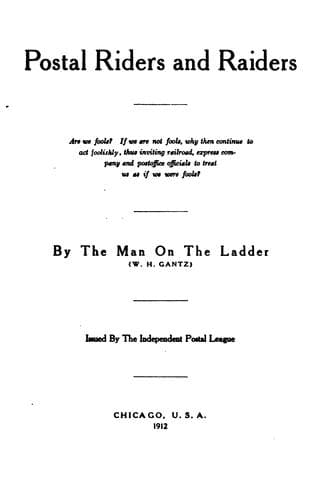
Postal service -- United States -- Second-class matter
The railroads have become the express companies, not in legal
fiction, but in transportational fact. The railroads largely own
the express companies, entirely control the express companies,
and, to all intents and purposes, are the express companies. We,
the highly intelligent American people, simply don’t know these
facts. Never has it seemed to occur to us that, since Benjamin
Harrison was President and John Wanamaker was in his cabinet, the
express grafters may have devised improved ways of working the
express graft. Therefore, in this parcels post matter, we don’t
know who is pushing the knife that we feel between our ribs. We
accuse the express companies. A man who was being murdered might
as well accuse the shadow of his murderer.
Perhaps the facts that follow will show you who are behind the
shadows of the express companies. I quote from Senate Document
No. 278, Sixtieth Congress:
Stock held by railways in express companies $20,668,000
Railway securities owned by express companies 34,542,950
Holdings of express companies in the stock of other
express companies 11,618,125
Since this article was written (Mr. Benson adds in a footnote)
the Interstate Commerce Commission has issued a report in which
railroad holdings in express stock are given at $14,124,000. The
same report says the “total book value of property and equipment
of 13 express companies is $22,313,575.53.” The figures furnished
by the express companies are evidently somewhat bewildering
to the commission, which, having found the total value of the
express companies’ assets to be $186,221,380.54, remarks: “It
is evident that the capital stock of these companies bears no
relation to the amount invested in the express business.” On
the face of the Interstate Commerce Commission’s report, the
railroads have disposed of more than $6,000,000 worth of express
stock since the United States Senate investigated the matter
during the life of the Sixtieth Congress. Yet there is no mention
of such a transaction, and it seems exceedingly unlikely that
the railroads have suddenly reversed their policies and become
sellers instead of buyers of express stock. What seems more
likely is that both the railroads and the express companies are
continuing the policy to use figures to conceal facts. Gentlemen
who can give $186,000,000 worth of assets a “book value” of
$22,000,000 might have no difficulty in compelling figures to
turn flip-flaps upon almost any occasion.
Public-domain text, read in full here on John Shaqi.
Reviews
Reviews
No reviews yet
Be the first to share your thoughts on this work.
Elsewhere in the archive
Join the Discussion
Join the discussion
Sign in to leave a comment or review.
Sign InorCreate an account