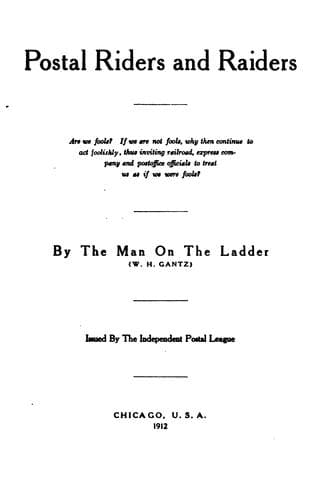
Postal service -- United States -- Second-class matter
In the whole history of the Postoffice Department, neither an
increase of second-class matter nor a reduction of the postage
rate has ever increased deficits, no matter what burdens have
been piled upon the service in the way of an extension of
city delivery, the establishment of rural free delivery, the
multiplication in number and increase of pay of officials,
increase of government free matter, increase of railroad and
other transportation charges, nor an increase in the obstructive
energies of postal officials directed against the publishing
business. (See In Memoriam, page 49.)
It has come to be generally understood and conceded that
second-class matter originates mail of the other classes. The
Postal Commission testifies that “No sane man will deny that
second-class matter is the immediate cause of great quantities
of first-class matter.” Mr. Madden and Mr. Lawshe said the same
thing. Meyer said that “It is known that second-class matter is
instrumental in originating a large amount of other classes of
mail matter.” To what extent this is so can not be determined
with exactitude, but the official figures given throw a flood of
light on the subject.
There are four classes of (paid) mail matter--first, second,
third and fourth. The first comprises letters and postals, the
second newspapers and periodicals, the third circulars, and the
fourth merchandise.
How, of themselves, could the first, third and fourth classes
develop faster than the growth of population? Does not their
extension depend upon the business energy and the intellectual
activity of the people, and in turn do not these depend very
largely upon the circulation of the public press?
Will it, therefore, be deemed unreasonable to conclude that of
the $202,064,887.96 of stamps sold for the first, third and
fourth classes of mail matter last year, $150,000,000 of it
originated immediately, remotely and cumulatively from the second
class? How else than in some such way can we account for the
prodigious development of the postal business, which has outrun
population sixfold or more?
The late Senator Dolliver, at the American Periodical
Association’s banquet, at the New Willard hotel, at Washington,
a year ago, said: “I look upon every one of your little
advertisements as a traveling salesman for the industries of the
United States.”
The amazing development of the industries of the country is in
a large measure due to second-class matter; the great increase
of second-class matter is due to the low postage rate; and the
wonderful expansion of the postal establishment is based chiefly
upon the widespread distribution of newspapers and periodicals.
Public-domain text, read in full here on John Shaqi.
Reviews
Reviews
No reviews yet
Be the first to share your thoughts on this work.
Join the Discussion
Join the discussion
Sign in to leave a comment or review.
Sign InorCreate an account