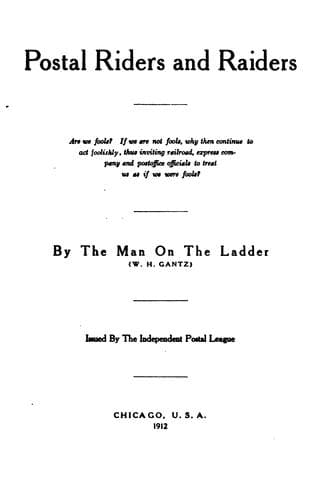
Postal service -- United States -- Second-class matter
In a printed statement recently issued by the president of one
of the leading magazine-publishing companies of New York City,
_the exceedingly profitable nature of the magazine business
was clearly set forth_. According to his statement the profits
of his own magazine for the _month of October, 1910, showed
an increase over the corresponding_ month for 1909 of 100 per
cent on advertisements and 151 per cent on _subscriptions,
making a net annual profit for dividends and surplus, based
on a circulation of 500,000 copies monthly, of $348,980_.
Regarding the periodical-publishing business in general, the
same gentleman says in his statement that “magazine publishers
receive _gross_ incomes as high as $6,000,000 in a single year.
Dividends amounting approximately to $1,000,000 yearly have
been made.” Speaking of the publishers of some of the magazines
joining in the protest against the proposed legislation, he says
that one of them, according to his own statement, realizes a net
profit of $1,000,000 annually; of another, the principal owner
of two great publications, that his gross income is more than
$6,000,000 annually, and that his net profits for the same period
exceed $1,000,000; of another, that his magazine yields more
than 10 per cent on a capital of $10,000,000; of another, that
his net profits are $600,000; of another, that the value of his
advertising space alone is $1,500,000 a year; of another, that
his advertising receipts are $75,000 per month and his profits
are from $600,000 to $800,000 per year; of still another, that
his publishing business represents a profit of 100 per cent a
year to its stockholders.
MY DEAR SENATOR:--On February 13, 1911, Everybody’s Magazine
published in the local newspapers a full page advertisement
attacking the proposed increase in second-class postage carried
by the postal bill now pending in the Senate. In their statement
the publishers claimed to have a circulation of 650,000 copies
per issue and asserted that “the postal measure now before
Congress increases the cost of handling Everybody’s Magazine
$150,000 a year.” They further stated that in view of the fact
that the magazine makes “each year for its stockholders about
$100,000,” the proposed increase would “actually exclude the
magazine from the mails.”
The department’s figures for the calendar year 1910 show that
Everybody’s Magazine mailed at the New York City postoffice
2,898,372 pounds of its issues as second-class matter, on which
the postage at the cent-a-pound rate was $28,983.72. As an
average of one-half of the pages is devoted to advertising, the
proposed increase of 3 cents per pound on such matter would make
the additional postage $43,475.58 per annum instead of $150,000,
as stated by the publishers of the magazine.
Public-domain text, read in full here on John Shaqi.
Reviews
Reviews
No reviews yet
Be the first to share your thoughts on this work.
Join the Discussion
Join the discussion
Sign in to leave a comment or review.
Sign InorCreate an account