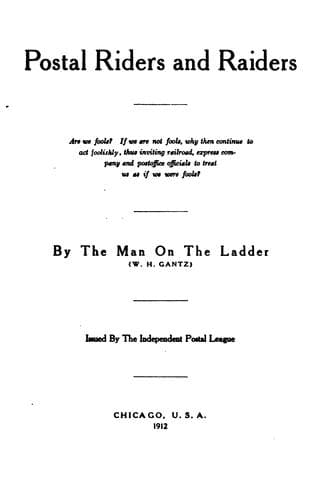
Postal service -- United States -- Second-class matter
Investigations recently made by the Postoffice Department
show that large numbers of periodical publications already
entered as second-class matter are in reality nothing more than
trade catalogues, which, under the law, ought to be treated
as third-class matter and subjected to a postage charge of 8
cents a pound, which is the rate for catalogues. By inserting
a few pages of reading matter, these publications succeeded
in being classed as magazines and thus secured admission at
the cent-a-pound rate. Among publications of this kind is one
containing 140 pages, 99 per cent of which are devoted to
advertisements; another containing 562 pages, 97 per cent of
which are devoted to advertisements; another containing 238
pages, 93 per cent of which are devoted to advertisements; and
another containing 268 pages, 89 per cent of which are devoted
to advertisements. Almost the entire space in these publications
is devoted to the carrying of commercial advertisements, and
this in defiance of the statute specifically excluding from the
second-class privileges “publications designed primarily for
advertising purposes.”
By the proposed law, magazines, in so far as they provide public
information, are left exactly on a par with newspapers and the
smaller periodicals, for the increase of rate of 3 cents a pound
attaches only to such portions of the magazines as are devoted to
advertising purposes.
The stock argument of magazine publishers that the profit to the
government on first-class matter induced by the advertisements in
their publications offsets any loss incurred by reason of the low
postage rate on second-class matter is disproved by the fact that
the government’s entire profit on first-class matter is less than
the total loss on second-class mail matter.
During the fiscal year 1910 over 800,000,000 pounds of
second-class matter were carried through the mails at a loss to
the government of $62,000,000. The profits on all other classes
of mail matter were more than swallowed up by this tremendous
loss, leaving a postal deficit for the year of about $6,000,000.
It is estimated that the annual saving to the government through
the proposed increase in postage will amount to about $6,000,000,
or enough to wipe out what remains of the deficit.
Public-domain text, read in full here on John Shaqi.
Reviews
Reviews
No reviews yet
Be the first to share your thoughts on this work.
Join the Discussion
Join the discussion
Sign in to leave a comment or review.
Sign InorCreate an account