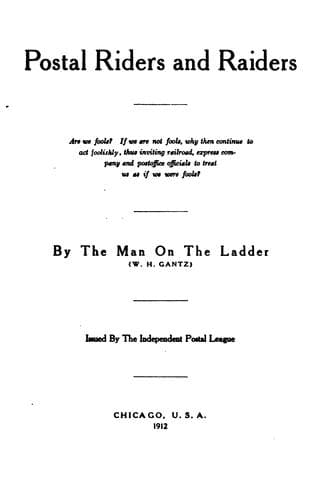
Postal service -- United States -- Second-class matter
_Second_--His colossally unjust and unfair way of figuring his “deficit”
against such periodicals. Maybe it was Britt, Third Assistant Postmaster
General, or some other “pied” subordinate who did the figuring. I do
not know. However, in common with other citizens, I hold Mr. Hitchcock
responsible for those figures, as we are fully warranted in doing by
reason of his official position.
_Third_--Mr. Hitchcock, it appears, in his reports and letters, gives
us a lot of talk that is _twisted_, “pretzel talk,” someone has aptly
called it. This “night-crawler” talk quite naturally--legitimately, if
not naturally--leaves thoughtful people to wonder what he wants, _what he
is after_, what interest or interests he is trying to subserve and what
“influences” have _influenced_ him to go after certain periodicals in so
_bald and crude a way_.
Still, that does not altogether fully express my third objection to Mr.
Hitchcock and his methods. His letters and special reports in support of
the absurd claim that the transportation and handling of second-class
mail matter costs 9.23 cents per pound, a figure above or equal to that
which will carry gold or currency bills _by express_ for the average
mail haul, furnish valid grounds for doubt as to the good faith of
his intent, to suspicion an _ulterior motive_ back of his action and
writings. To this I do not hesitate to say that his 1910 report, I mean
his own personally signed section of it, is offensively _bureaucratic_.
Mr. Hitchcock, it appears from his own recommendations, would have his
bureau or department bigger than Congress. He wants powers and authority
centered in it which Congress _should not delegate, which Congress has no
rightful powers nor authority to delegate_.
Now, do not misapprehend me. Maybe Mr. Hitchcock has not done all this
on his own initiative. He may have acted wholly on a long-distance or
a central direction from the main stem. I shall, however, proceed to
support my accusation that Mr. Hitchcock evidences in his 1910 report a
desire--a tendency, if not a desire,--to make the Postmaster General not
only a censor of periodical literature (as indicated in the wording of
that “rider” amendment printed on a previous page), but to have delegated
to him powers over the mail service which not only contravene the basic
principles of a democratic form of government, but which, also, tend
to establish a bureaucracy that, if carried to its full flower, will,
necessarily _abrogate our form of government itself_.
Public-domain text, read in full here on John Shaqi.
Reviews
Reviews
No reviews yet
Be the first to share your thoughts on this work.
Elsewhere in the archive
Join the Discussion
Join the discussion
Sign in to leave a comment or review.
Sign InorCreate an account