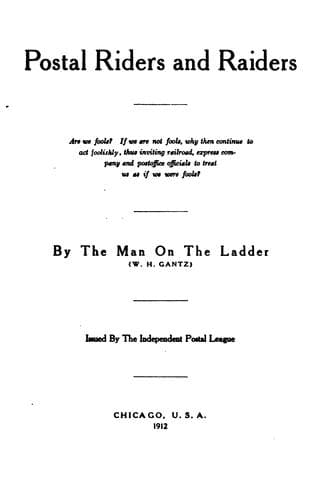
Postal service -- United States -- Second-class matter
Here let us note Mr. Hitchcock’s recommended legislation. In the report
before me he makes thirty-six recommendations. In each of these which
grants added powers or authority touching any matter, the wording of
the suggested legislation gives such added powers and authority to the
_Postmaster General_. In certain minor matters, especially such as relate
only to departmental methods of handling its service accounts, etc., such
grant of power is entirely proper. Among Mr. Hitchcock’s recommendations
are several of such character, and, so far as I have studied them, they
appear sound, and consequently their passage by Congress and their
application to the department would, in my judgment, effect material
savings or betterments in the service.
In a number of other instances, however, Mr. Hitchcock asks legislation
that will grant him (or any succeeding head of the federal Postoffice
Department), powers and authority which _should be granted to no bureau
or departmental division of our government service_. I mean that
the acquirement of such legislative powers and authority by bureaus
(cabinet service divisions), is inimical to the basic principles of our
government; in fact, it is a _stealthy_ move to establish in this country
the bureaucratic form of government which has proved a curse in every
existing monarchical government, causing their peoples to rebel against
them, or constantly a condition of unrest under the system--a condition
which indicates either _enforced_ submission to governmental wrongs and
impositions or a dwarfed and submerged manhood, “begging for leave to
live” and devoting most of its thought to a few questions, such as: “Why
did I arrive? What am I here for? I work, why does the government take
most of my earnings? Why does the government and its bureau heads live,
live in luxury, while I and my wife and children merely exist,--barely
subsist? _Why are hundreds of millions taken every year from people who
need it to secure the common comforts of life, and given, unearned, to
those who need it not at all?_”
It would require pages even to print the inquiries which the victims of
bureaucratic governments ask themselves daily, ask themselves daily so
long as they _exist above the level of the clod_, above the level which
Edward Markham so forcefully and eloquently depicts in his “Man with the
Hoe.”
The point I desire to emphasize is that when the great body of people
in any country--its “citizens”--begin to ask themselves such questions,
_their patriotism begins to dry-rot and die_, and when the patriotism of
a nation’s people begins to die, that nation is on the farther slope of
its existence; it has started on the decline, more or less sharp, _which
ends in rebellion_, dissolution, extinction. This is the uniform lesson
of history. He who reads it not so reads either not carefully or not
comprehendingly.
Public-domain text, read in full here on John Shaqi.
Reviews
Reviews
No reviews yet
Be the first to share your thoughts on this work.
Elsewhere in the archive
Join the Discussion
Join the discussion
Sign in to leave a comment or review.
Sign InorCreate an account