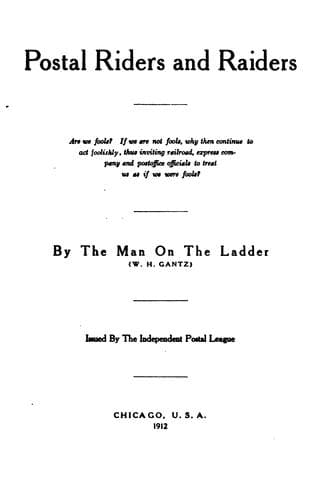
Postal service -- United States -- Second-class matter
Mr. Hitchcock’s “rider” to the 1911 postoffice appropriation bill and
his recent letters to Senator Penrose and others will convince any
fair-minded, informed reader that he is either an “influenced” man or
is densely ignorant. I wish to make this point emphatic: The careless,
loose, hurried--yes, even silly--wording of that “rider” and the false
and foolish statements in his letters to Senator Penrose, relating to his
demand for an increase of three cents a pound on certain periodicals now
carried in the mails as second-class matter at one cent a pound, he to be
given authority to pick out and designate the periodicals which should be
subject to the increased rate--his false and foolish statements in that
“rider,” and in his recent letters, I say, must show to any intelligent
mind that Mr. Hitchcock is either an “influenced” man or a six-cylinder,
chain-tired, hill-climber of an ignoramus in matters relating to
periodical publication, and also in many essential matters relating to
his department.
My previous statements regarding the government’s postoffice department,
about Postmaster Generals in general and about Mr. Hitchcock in
particular, may not be up to the broadcloth of dignity, but they do carry
the dignity of fact and _truth_, as I shall proceed to demonstrate to my
readers.
Let us consider first the government postoffice department and then Mr.
Hitchcock’s recent actions and utterances.
Most of the Postmaster Generals, including Mr. Hitchcock, appear to have
been greatly exercised about “deficits,” yet persist in pursuing methods
of business management and direction that must, almost necessarily, make
expenditures of the department exceed its receipts.
Also I may ask, in this connection, why so much agony, or “front,”
whichever it may be, about a “deficit” in the Postoffice Department? The
postal service of the country is a public service, _a service of all the
people. As such the revenues of the federal postoffice department should
not be permitted to exceed the actual cost of the service rendered under
honest, economical and competent management and direction._
Public-domain text, read in full here on John Shaqi.
Reviews
Reviews
No reviews yet
Be the first to share your thoughts on this work.
Join the Discussion
Join the discussion
Sign in to leave a comment or review.
Sign InorCreate an account