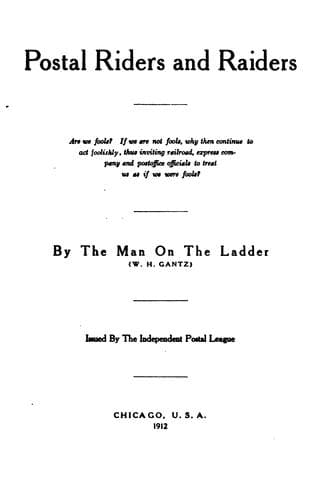
Postal service -- United States -- Second-class matter
Although this graduated scale would appear to be more favorable
to the smaller periodical than to the large one, it must be borne
in mind that the periodical weighing _less than 1 ounce_ and of
necessity paying the initial rate of _one-quarter cent_ would
be paying a rate (2 cents per pound), slightly greater than the
large periodical. This increase upon the periodical weighing less
than 2 ounces finds ample justification in the obvious fact that
the expense of handling second class matter is not to be measured
simply by gross weight. On the contrary, as was pointed out by
the representatives of the publishers in comparing the cost of
handling second-class with that of first-class mail, such expense
is to be measured by the number of pieces handled and frequency
of handling. _A pound of periodicals which is made up of 10 or
12 or, as is sometimes the case, 30 or 40 separate pieces, each
one of which requires a separate course of handling and delivery,
can not with justice be treated as the equivalent of a pound
of matter which requires but two, or, at most, four courses of
handling and delivery._
This increase would be offset, moreover, for the _normal_
periodical weighing less than 2 ounces, the country weekly, by
the retention of the free county privilege.
The foregoing is substantially the commission’s _whole_ argument, save
a little more talk about “normal” periodicals, “normal” weeklies, and a
statement to the effect that all countries, other than the United States
and Canada, increase the piece, or copy, postage rate as the weight of
the periodical increases--that is, these other countries do not give a
_flat_ pound, gram or other unit of weight rate.
Now, I shall briefly state my objections to some points in the above
quotation--those points I have italicized.
The reader, however, must bear in mind that the scale of increase in
mail rates above reprinted applies _only to single copies_--to copies
mailed to individual addresses. For copies mailed in _bulk_, in packages
weighing not less than ten pounds, to some agent of the publisher or
other individual, to be taken up by the agent or individual at train or
at central postoffice, the commission recommended the cent-a-pound rate.
In adverse criticism of the commission’s argument for penalizing
_weight_, because all foreign countries do so, I need but say:
1. There are more high-class newspapers--papers which, necessarily, have
weight--published in this country _than is published in all the rest of
the world_.
2. There are four times as many of what the 1906-7 commission--also
Postmaster General Hitchcock--would class as “periodicals” published in
this country _as are published in all the rest of the world_.
Public-domain text, read in full here on John Shaqi.
Reviews
Reviews
No reviews yet
Be the first to share your thoughts on this work.
Elsewhere in the archive
Join the Discussion
Join the discussion
Sign in to leave a comment or review.
Sign InorCreate an account