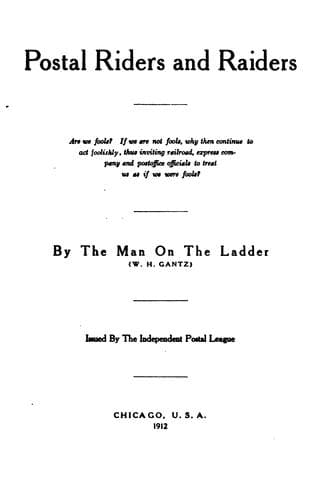
Postal service -- United States -- Second-class matter
Sounds “loud,” does it? Well, look into the matter. Maybe I am mistaken.
If so, it is a mistake made after thirty years of study of the conditions
controlling in my country--in _your_ country--and of the prices paid in
other countries for _efficient, satisfactory service_.
3. Those “other countries”--the stronger ones, at any rate--either _own_
or _absolutely control_ the railroads which transport their mails. In
some of them, rail transportation of mails--also of government officials,
the service personnel of the army and the navy, and of other government
“weight”--are _carried free of charge_.
4. Those “other countries,” of which so much is said and written
ostensibly for our enlightenment, have gone through the mill--their
peoples have been _ground fine_ in mills of sophistry and special
pleadings, to which, _for fifty years_, we have been carrying our grists.
5. Those “other countries” are making their mail service a source of
_governmental revenue_.
The people of this country, today, no more expect a revenue from the
government’s postal service than they expect it from the War, the Navy,
the Interior, the Judicial or other service department.
The people want _service_, not revenues, from any federal service
department.
And you gentlemen who vote away the people’s money for services _not_
rendered--which you _know_ will not be rendered when you vote to “burn”
the money--will, before those independent periodicals are through with
the recent sand-bagging attempt to censor or control their _published
thought_--you will learn, I mean to say, that people want _service_
not revenues; that they want “duty,” as an engineer would name it, not
a _coached_ prattle about B. T. U. or other legislative and official
thermics.
Now, let us look back at that quotation--at some of the points in it I
have italicized.
First paragraph quoted: Aside from small country dailies--now carried by
mail to addresses inside the county of publication free--and fraternal
papers, Sunday School sheets and similar publications, there are few
periodicals published in this country which weigh two ounces or less.
First paragraph following tabulation: “The rate would average 1⅞ cents
per pound” for periodicals weighing two pounds.
A glance at the table shows that the piece or copy rate on a periodical
weighing 28 ounces is given as 3¼ cents. A periodical weighing two
pounds, or 32 ounces, would be charged a half cent more, or 3¾ cents for
mail carriage and delivery, instead of 2 cents as now.
Second paragraph following the table, also in last paragraph quoted:
“Normal” periodicals.
Public-domain text, read in full here on John Shaqi.
Reviews
Reviews
No reviews yet
Be the first to share your thoughts on this work.
Elsewhere in the archive
Join the Discussion
Join the discussion
Sign in to leave a comment or review.
Sign InorCreate an account