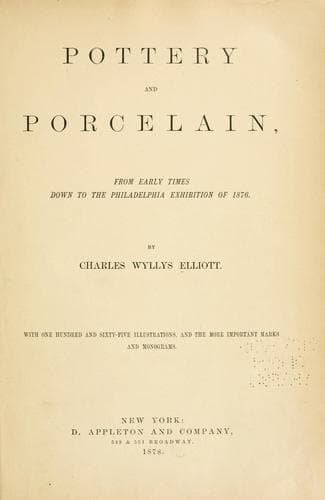
Pottery and Porcelain, from early times down to the Philadelphia exhibition of 1876Elliott, Charles Wyllys
History
Pottery and Porcelain, from early times down to the Philadelphia exhibition of 1876
Elliott, Charles Wyllys
Pottery -- History; Pottery -- Marks
Marco Polo visited China in the latter half of the thirteenth century,
and he told of the great factories for the production of porcelain
there; and how certain kinds of earth were collected, and, after being
exposed to air and rains for thirty or forty years, were then fit to be
made into cups and bowls. Great quantities were sold in the city. "For a
Venetian groat you may purchase eight porcelain cups."
Beginning of course with useful articles simply, this manufacture
progressed until pots and vases and dishes were made for purely
decorative purposes.
[Illustration: FIG. 98.--_Porcelain Bottle, from Egyptian Tomb._]
As porcelain was introduced into Europe by the Portuguese about the year
1518, we are obliged to pierce into the dimness of the past with the aid
of the Chinese themselves. M. Julien,[9] a Frenchman, has compiled from
the Chinese writings mostly all we know, some parts of which may come
into this chapter. Jacquemart, Marryat, Chaffers, Demmin, and others,
have drawn from him.
As early as the Tchoin dynasty (about 583) fine qualities were produced,
and the court of the emperors demanded it. Artists began to appear, and
rare and rarer qualities were made. We find that different styles were
sought for and were held in highest esteem; that "the Tsin held the blue
china in high estimation;" the Soni or Sui (581 to 618) gave the
preference to green. The Thang dynasty (618 to 907) required that it
should be white; and in 621 Ho made porcelain for the emperor of a white
ground, "brilliant as jade;" while the Emperor Tchi-tsong (954 to 959)
gave his family name to a beautiful blue, the most highly esteemed of
all the ancient porcelains of China.[10] How fine this was we cannot
know, as it is not likely that any piece of it exists with us, even if
among the Chinese. The production grew, until in 1369 in the city of
King-te-chin, according to the statement of Father d'Entrecolles, it
was estimated at a million pieces a year. A vast and varied industry in
making china was carried forward here, down even to the present times,
when the Taiping rebels (who we are told were _Christians_) completely
destroyed it.
From the accounts, mostly of the French missionaries, it seems that
while the three thousand furnaces at King-te-chin baked the porcelain
which was modeled there, it was taken to Nanking and Canton to be
decorated; and, as far as we know, the painting of Nanking was superior
to that of Canton. King-te-chin is swept away, and Nanking is almost
destroyed; so that we can expect no more fine art-work in porcelain from
China.
It is likely, however, that much decoration was done at the great city
of King-te-chin; but what we know now as "the celestial" or Nanking blue
was probably done at Nanking; of this more will be said in the progress
of this chapter.
Public-domain text, read in full here on John Shaqi.
Reviews
Reviews
No reviews yet
Be the first to share your thoughts on this work.
Elsewhere in the archive
Join the Discussion
Join the discussion
Sign in to leave a comment or review.
Sign InorCreate an account