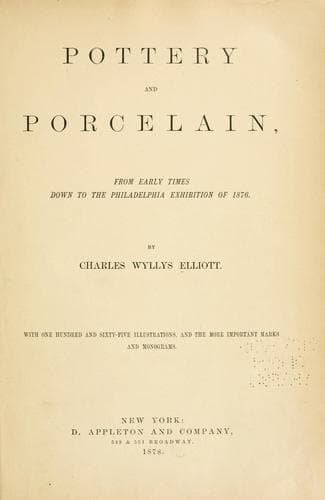
Pottery and Porcelain, from early times down to the Philadelphia exhibition of 1876Elliott, Charles Wyllys
History
Pottery and Porcelain, from early times down to the Philadelphia exhibition of 1876
Elliott, Charles Wyllys
Pottery -- History; Pottery -- Marks
It is impossible here to dwell upon or to know much of the various
descriptions of china made down to the period of the Ming dynasty (1368
to 1649). Upon the productions of this period the Chinese collectors and
antiquaries place the highest value--in many cases much greater even
than is now given to them in Europe.
Some examples of this period are to be seen in Europe and a few in
America.
One of our commissioners, who met the Chinese and Japanese at the Vienna
Exposition, was told by them that they were purchasing choice pieces of
porcelain, intending to take them back to their countries, where they
are more valuable than in Europe: for, from the earliest days, it seems
that both the Chinese and Japanese have been keen critics and lovers of
this most fascinating work.
Jacquemart and others have attempted to arrange the decorated work into
groups as follows:
The ARCHAIC--of which perhaps none exists.
The CHRYSANTHEMO-PÆONIENNE.
The FAMILLE-VERT, or GREEN.
The FAMILLE-ROSE, or PINK.
Besides these are many sub-varieties. These groups indicate the style
of decoration of which we shall attempt to give some sketches, although,
as they want color, they must necessarily be faint.
The chrysanthemo-pæonienne exhibits the use in various ways of the
chrysanthemum and peony. We give here examples to show the style of
decoration, as far as we are able to do it without color.
[Illustration: FIG. 99.--_Pot from Mrs. Burlingame's Collection._]
Fig. 99 is a pot from Mrs. Burlingame's collection. It stands about
twenty inches high, and is a fine example of the early style of work.
The paste and glaze are not so good as in the rose family, but still all
is excellent. The chrysanthemums are yellow, red, and black. This work
is no doubt very old.
We give (Fig. 100) a sketch of a small snuff-bottle from the same
collection, drawn the real size. It is a perfect piece of work: the
paste
[Illustration: FIG. 100.--_From Mrs. Burlingame's Collection._]
[Illustration: FIG. 101.--_From Mrs. Burlingame's Collection._]
is a fine white; the overturned preserve-pot is a clear lemon-yellow,
with a little color in the rings; the grasshopper is alive and is
brilliant with greens, blacks, and blues. The stopper is a bit of purple
amethyst. It is so _complete_ that it fills the mind with satisfaction,
more thorough than the sight of St. Peter's can give.
[Illustration: FIG. 102.--_Chinese Vase._]
[Illustration: FIG. 103.--_From Miss Wyman's Collection._]
The _famille-vert_, or green, is so called because a clear, brilliant
green is the only or prevailing color.
The plate here shown (Fig. 101) is also from Mrs. Burlingame's
collection. The paste is a brilliant white, the glaze perfect; and the
dragons, in green, have all that freedom and fancy for which the early
Chinese artists were remarkable.
Public-domain text, read in full here on John Shaqi.
Reviews
Reviews
No reviews yet
Be the first to share your thoughts on this work.
Elsewhere in the archive
Join the Discussion
Join the discussion
Sign in to leave a comment or review.
Sign InorCreate an account