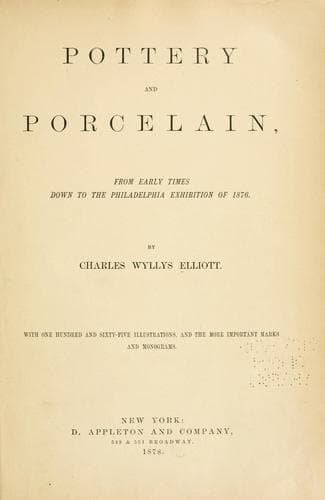
Pottery and Porcelain, from early times down to the Philadelphia exhibition of 1876Elliott, Charles Wyllys
History
Pottery and Porcelain, from early times down to the Philadelphia exhibition of 1876
Elliott, Charles Wyllys
Pottery -- History; Pottery -- Marks
A large collection of their pottery was shown at the United States
Exhibition in Philadelphia in 1876, and there is a sufficient and most
interesting exhibit of it in the Peabody Museum at Harvard in Cambridge.
In this collection, also, are to be found many examples of like unglazed
pottery found in the Western mounds of the United States by Professors
Shaler and Carr, who for some years have been engaged in researches in
Kentucky and at other points in the West.
Upon some examples of this American pottery (Figs. 8 to 15) are to be
seen decorations in color, mostly red, black, and brown; and it would
seem impossible that these colors should have lasted through so many
centuries, if they were not fixed by fire, and therefore were mineral.
[Illustration: FIG. 20.--_Pottery of Ancient Gaul._]
The decorations, too, were somewhat varied, but in none which I have
seen do they go beyond the elementary styles already mentioned.
The production of idols and fantastic vases, animals and grotesques,
must have been extensive, as so many of these have already been found;
indicating that they must have been common in their day. Examples of
this fantastic decoration and modeling are seen in Figs. 12 to 15--and
in Fig. 14 is an approach to portraiture. In one (Fig. 15) is seen the
double-bellied bottle, so much in use in China and Japan. The
twin-bottles seen in Figs. 8 and 9 are good examples of a fancy which
evidently pleased potter and people in those "good old Peruvian times."
A most singular fact is mentioned by Demmin, that on one of their
_casseroles_ the handle is clearly the phallus, symbol of life, found on
Egyptian sculptures, and once worshiped.
One curious fact is asserted by the French _savants_,[1] that there is
abundant evidence to show that through a long succession of years,
perhaps three thousand, the character of these American potteries grew
less and less pure and simple, and more and more debased and vulgar;
which one can well believe, when we see everywhere that whole nations,
some of them calling themselves civilized, have gone the same road,
downward from the good to the bad, and not upward toward the true and
the beautiful.
[Illustration: FIG. 21.--_Ancient Gaul._]
The opening of the CESNOLA collections, at the New York Museum of Arts,
shows us a vast number of early potteries which are as yet hardly
classified or understood. Many of them bear marks of Assyrian or of
Phoenician inspiration; and among them are rude vessels closely
resembling those of Peru, and also many grotesque forms of vases and
animals, such as mark the early attempts at Art in other nations. That
collection should be examined by those who are interested in this
subject.
The hand-book published by the Museum is full of condensed information,
and should be carefully preserved.
Public-domain text, read in full here on John Shaqi.
Reviews
Reviews
No reviews yet
Be the first to share your thoughts on this work.
Join the Discussion
Join the discussion
Sign in to leave a comment or review.
Sign InorCreate an account