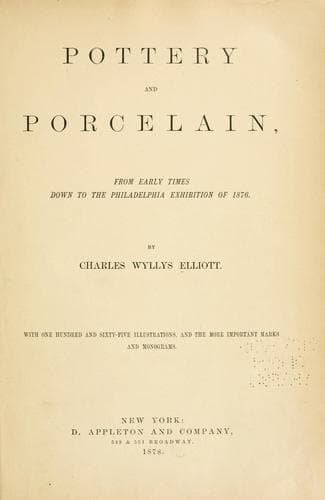
Pottery and Porcelain, from early times down to the Philadelphia exhibition of 1876Elliott, Charles Wyllys
History
Pottery and Porcelain, from early times down to the Philadelphia exhibition of 1876
Elliott, Charles Wyllys
Pottery -- History; Pottery -- Marks
The sea-greens (_céladons_) are among the rarest Chinese colors, and
some pieces are thought to be among the oldest--dating back possibly one
thousand years.
The violets and crimsons are also rare and beautiful; they are almost
always applied to vases and bottles; and are often flamed, splashed, or
clouded.
The imperial yellow, some pieces of which are in the Green Vaults at
Dresden, was never sold; it was made only for the royal family of
Peking. I have not seen it, but it is described as a very clear and
beautiful citron-color. Marryat mentions two pieces in Mr. Beckford's
collection as having been sold for their weight in gold; they would now
sell for ten times that.
The small incense-pot (Fig. 111) is from Mr. Avery's collection. It is a
very pure lemon-yellow, and is quaint in form and peculiar in every way.
Nothing can be better here than the condensed information prepared for
his catalogue by Mr. A. W. Franks. It is as follows:
"The tints are very numerous; we find, for instance, sea-green or
_céladon_, yellow, red, blue, purple, brown, black, and several
variegated hues. These glazes owe their color to various metallic
oxides, of which an account may be found in the 'History of
King-te-chin,' book vi., section xi. The exact tint must be in some
measure due to the amount of firing which the vase has undergone, and
the mottlings and other variations of color which they present must have
been to a certain extent accidental.
"Among these simple colors the first place must be assigned to the
bluish or sea-green tint, termed by the French _céladon_. It is probably
of considerable antiquity; and it is remarkable that the earliest
specimen of porcelain that can now be referred to as having been brought
to England before the Reformation--the cup of Archbishop Warham, at New
College, Oxford--is of this kind. By the Persians and Turks it is termed
_mertebani_, and it is much valued by them as a detector of poisonous
food. Specimens of this porcelain were sent to Lorenzo de' Medici, in
1487, by the Sultan of Egypt. It owes its preservation, no doubt, to its
great thickness. The surface is sometimes covered with impressed or
engraved patterns filled in with the glaze.
"Yellow glazed porcelain is much valued by collectors, owing to the
supposed scarcity of specimens of this color, it being the imperial
color of the reigning dynasty. Many of them, however, bear dates of the
Ming dynasty, when the imperial color was green, and can therefore have
no relation to the emperor.
"The red glaze is of considerable antiquity; some of the vases made
under the Sung dynasty at Tsing-cheou are mentioned as resembling
chiseled red jade. One tint, the _sang de boeuf_ of French collectors,
is much valued in China. Occasionally portions of red glazed vases
appear purple, owing probably to a different chemical condition of the
coloring-matter in those parts.
Public-domain text, read in full here on John Shaqi.
Reviews
Reviews
No reviews yet
Be the first to share your thoughts on this work.
Elsewhere in the archive
Join the Discussion
Join the discussion
Sign in to leave a comment or review.
Sign InorCreate an account