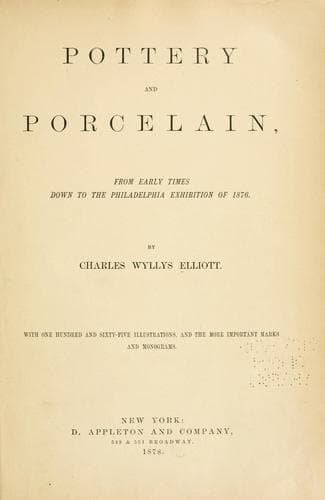
Pottery and Porcelain, from early times down to the Philadelphia exhibition of 1876Elliott, Charles Wyllys
History
Pottery and Porcelain, from early times down to the Philadelphia exhibition of 1876
Elliott, Charles Wyllys
Pottery -- History; Pottery -- Marks
"Blue glazes must have come into use in very early times, as blue is
stated to have been the color of the vases of the Tsin dynasty (A. D.
265 to 419). The tints appear to have varied greatly, one of the most
celebrated being the blue of the sky after rain, which was the tint
selected for the palace use by the Emperor Chi-tsung (954 to 959).
"The purple glaze is another beautiful variety. Specimens of this color
are mentioned as early as the Sung dynasty (900 to 1279). The brown and
coffee-colored glazes do not appear to be very ancient, as Père
d'Entrecolles, writing in 1712, mentions them as recent inventions.
"A brilliant black glaze is by no means common, excepting where it is
used in combination with gilding, and is probably not very ancient, as a
brilliant black is said to have been invented under the reign of the
Emperor Keen-lung (1736 to 1795).
"The variegated and mottled glazes may properly be included under this
head, as they owe their appearance not so much to a difference in the
coloring-matter as in the mode in which it is applied. They are called
by the French _flambé_, and were no doubt originally accidentally
produced. According to Père d'Entrecolles (second letter, section xi.),
such vases are called _Yao pien_, or transmutation-vases.
"It is probable that many of the specimens which are covered with single
glazes are of a coarse ware--rather a kind of stone-ware than true
porcelain. Some of the glazes have been applied at a somewhat lower
temperature, called by the French _demi-grand feu_."
Porcelain-painting is done in two ways: under the glaze directly on the
clay, or upon the glaze. Most of it is upon the glaze, into which it is
melted by a mild heat. To show to the uninitiated what time, talent, and
labor, are applied to pottery and porcelain, it may be well to state
that fine work requires many firings, and that the delicate teacup,
which fools hardly look at, passes through some seventy hands to reach
its perfectness! In some eyes a big thing (even if ugly) is admirable; a
small thing, however beautiful, is contemptible. In the eye of God is
anything small, anything large?
ENAMELING is a style of glaze mostly applied to a stronger, more opaque
body, often not porcelain at all. The enamel, which is made from oxide
of tin, may be applied in masses of color upon the glaze so as to
produce the effect of slight relief, or cameo. Much of it is beautiful,
but it often lacks the fineness and preciousness of china.
Of the EGG-SHELL china most have seen excellent examples brought from
Japan, where it is now made. The cups are turned down to an extreme
thinness, almost to that of thick writing-paper, before the last glaze
is applied. The oldest egg-shell was a pure white; later, flowers in
colors were applied.
[Illustration: FIG. 112.--_Grains-of-Rice Pot._]
Public-domain text, read in full here on John Shaqi.
Reviews
Reviews
No reviews yet
Be the first to share your thoughts on this work.
Elsewhere in the archive
Join the Discussion
Join the discussion
Sign in to leave a comment or review.
Sign InorCreate an account