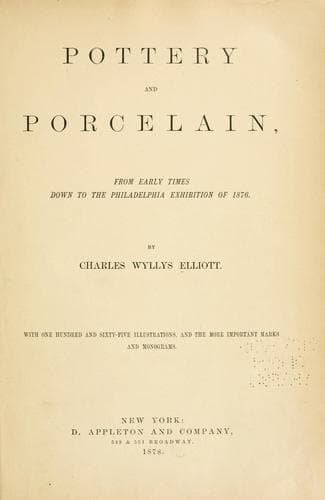
Pottery and Porcelain, from early times down to the Philadelphia exhibition of 1876Elliott, Charles Wyllys
History
Pottery and Porcelain, from early times down to the Philadelphia exhibition of 1876
Elliott, Charles Wyllys
Pottery -- History; Pottery -- Marks
"As we have already said, however, the native accounts do not furnish
much information that can be rendered available; but they show very
clearly that at all times the porcelain-makers were in the habit of
copying the works of their predecessors, and instances are given where
they have even succeeded in imposing upon the best judges of their own
country.
"The places at which manufactories of porcelain have existed or still
exist in China are very numerous, no less than fifty-seven being
recorded in the 'History of King-te-chin.' They extend to thirteen of
the eighteen provinces into which the country is divided, but are
especially numerous in Honan, Chihkiang, and Kiangsi, probably owing to
the presence of the materials for the manufacture in these provinces.
The following is a summary:
Chihli 5
Keang-nan 5
Shansi 5
Shantung 2
Honan 13
Shensi 4
Kansuh 1
Chihkiang 8
Kiangsi 8
Szechuen 1
Fokien 2
Kwangtung 1
Hoonan 2
"Of all these manufactories, the most famous appears to be that of
King-te-chin, in the province of Kiangsi. It has long been the site of a
fabrique, as in A. D. 583 the then emperor ordered the inhabitants of
the district now called King-te-chin to send him porcelain vases. The
old name was Chang-nan-chin, and the present one was assumed in the
period King-te (A. D. 1004 to 1007), whence its name. In 1712 Père
d'Entrecolles states that there were three thousand porcelain furnaces
in this town, which found employment for an immense multitude of people.
The manufactory has suffered severely, as we have already stated, during
the rebellion of the Taipings.
"Porcelain is termed by the Chinese _Yao_, a name which seems to have
been brought into use at the commencement of the Tang dynasty (A. D.
618), before which it had been called _Tao_. The word 'porcelain' is
European, possibly Italian, and is supposed to have been derived from
the similarity of the glazed surface to that of the cowrie-shell
(_porcellana_), which itself took its name from its form (_porcella_, a
little pig). Marco Polo employs the word in both senses. In French
mediæval inventories the word '_pourcelaine_' is often found, and
evidently denoted a substance which could be sculptured. M. de Laborde
has collected a number of quotations, in the valuable 'Glossaire'
appended to his catalogue, of the enamels in the Louvre, and has come to
the conclusion that mother-of-pearl was intended; it will, however, be
safer to consider that the word was used for any kind of shell, the
cowrie and other shells being as well, or even better, adapted for
carving than mother-of-pearl. In later inventories the word seems to
have been used both for shell and Oriental porcelain.
Public-domain text, read in full here on John Shaqi.
Reviews
Reviews
No reviews yet
Be the first to share your thoughts on this work.
Elsewhere in the archive
Join the Discussion
Join the discussion
Sign in to leave a comment or review.
Sign InorCreate an account