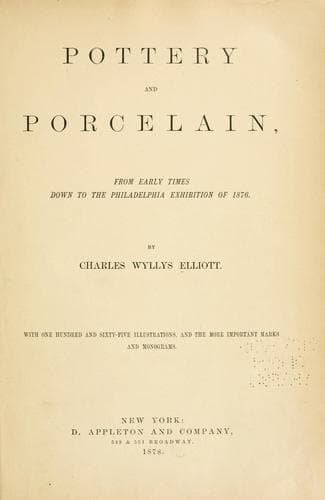
Pottery and Porcelain, from early times down to the Philadelphia exhibition of 1876Elliott, Charles Wyllys
History
Pottery and Porcelain, from early times down to the Philadelphia exhibition of 1876
Elliott, Charles Wyllys
Pottery -- History; Pottery -- Marks
"The claim of greatest antiquity that has been hitherto put forward for
specimens found out of the limits of the Celestial Empire have been in
favor of the little Chinese bottles, which were stated by Rossellini and
others to have been found in undisturbed Egyptian tombs, dating from not
less than 1800 years B. C. This claim has, however, been disallowed. The
bottles are of good white porcelain, painted in colors, and bearing
inscriptions. Now, we have seen that the Chinese themselves do not claim
a greater antiquity for the invention of porcelain than between B. C.
206 and A. D. 87. Color-painting must have been introduced at a much
later date. The inscriptions are in the grass-character, which was not
invented till B. C. 48, and contain passages from poems which were not
written till the eighth century of our era. They are, in fact, identical
with snuff-bottles still for sale in China. Their introduction,
therefore, into Egyptian tombs must have been due to the fraud of Arab
workmen. The whole subject has been gone into by M. Stanislas Julien, in
the preface to the 'History of King-te-chin,' as well as by others.
"The next claim has been made on behalf of the _murrhine_ vases of the
ancients, which are described as 'cooked in Parthian fires.' Now, it is
probable that, at the commencement of our era, Chinese porcelain was not
far advanced beyond pottery or stone-ware, and little superior to the
so-called Egyptian porcelain. No fragments of Chinese vases have been
found with Greek or Roman antiquities, nor of imitations of them in
other materials, so as to correspond with the false murrhine of the
ancients. It is therefore far more probable, as has been suggested by
Mr. Nesbitt, in his notes on the 'History of Glass-making,' that the
murrhine vases were made of agates and other hard stones, of which the
colors had been modified in the East by heating and staining. The false
murrhines would then be the glass bowls imitating hard stones, but with
various strange tints not to be found in natural stones.
"In 1171 we first find any distinct mention of porcelain out of China.
In that year Saladin sent to Nur-ed-din various presents, among which
were forty pieces of Chinese porcelain.
"Marco Polo, traveling in 1280, visited one of the sites of the
porcelain manufacture, and mentions that it was exported all over the
world. It is probable that he may have been the means of calling the
attention of his countrymen to this production of the far East. Many
other notices from travelers of the fourteenth and fifteenth centuries
might be cited. It was probably through Egypt that it reached Europe; at
any rate, a present of porcelain vases was sent by the Sultan of Egypt,
in 1487, to Lorenzo de' Medici. To the Portuguese is no doubt due the
first direct importation of Chinese wares into Europe, in which they
were followed by the various India companies of Holland, England,
France, Sweden, etc.
Public-domain text, read in full here on John Shaqi.
Reviews
Reviews
No reviews yet
Be the first to share your thoughts on this work.
Elsewhere in the archive
Join the Discussion
Join the discussion
Sign in to leave a comment or review.
Sign InorCreate an account