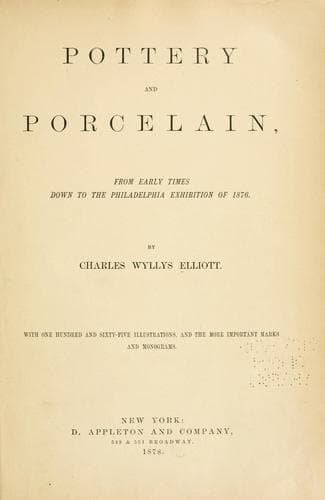
Pottery and Porcelain, from early times down to the Philadelphia exhibition of 1876Elliott, Charles Wyllys
History
Pottery and Porcelain, from early times down to the Philadelphia exhibition of 1876
Elliott, Charles Wyllys
Pottery -- History; Pottery -- Marks
"It may be convenient shortly to describe the mode of making porcelain
in China, as derived from the letters of Père d'Entrecolles (1712 to
1722), and the 'History of King-te-chin,' in which M. Julien has
reproduced the Chinese plates illustrating the processes.
"Porcelain in China is usually formed of two materials: the one, termed
in Chinese _Pe-tun-tse_, is a white, fusible material--a mixture of
feldspar and quartz, obtained from a pounded rock by repeated washing,
and formed into cakes or bricks, whence its Chinese name, 'white-clay
bricks;' the other, termed Kaolin from its locality, is infusible, being
a hydrated silicate of alumina, derived from the decomposed feldspar of
granite; this is also formed into cakes. These two materials, having
been thoroughly cleansed, are kneaded together in varying proportions,
and form a clay ready for the potter. The wet clay is turned on the
wheel or potter's table, and, after passing through the hands of several
workmen, who add handles and other accessories made in moulds, smooth
the surface, etc., the vessel is put out to dry, the foot still
remaining a solid mass; any decoration in blue, or other colors which
require to be highly fired, is then added. The glaze is next applied,
either by dipping, or by blowing it on with a tube. This strengthens the
vessel sufficiently to enable the workmen to fashion the foot on the
wheel, and to inscribe any mark; this being likewise coated with glaze,
the vessel is ready for the furnace. The pieces of porcelain are packed
in clay seggars to protect them from injury, and placed according to the
degree of heat which each specimen requires. The furnace is then
lighted, the entrance walled up, and it is kept supplied with wood
during a night and a day, when it is allowed to cool and the porcelain
removed. If enamel-colors are to be applied, it then passes into the
hands of the painters, who are very numerous, and each confined to his
own special detail; any gilding or silvering is added at this stage. It
is then baked again, at a much lower temperature, in a small muffle or
an open furnace. It should be mentioned that the glaze is formed of
Pe-tun-tse, mixed with fern-ashes and lime, but other materials are
occasionally used; for instance, Hwa-chi (steatite) is employed,
sometimes mixed with the glaze, as well as sometimes with the paste of
the porcelain. Any colors which will bear to be highly fired, and are
required to cover the whole surface, are mixed with the glaze before it
is applied.
Public-domain text, read in full here on John Shaqi.
Reviews
Reviews
No reviews yet
Be the first to share your thoughts on this work.
Elsewhere in the archive
Join the Discussion
Join the discussion
Sign in to leave a comment or review.
Sign InorCreate an account