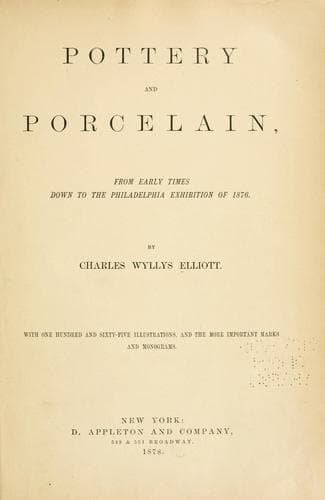
Pottery and Porcelain, from early times down to the Philadelphia exhibition of 1876Elliott, Charles Wyllys
History
Pottery and Porcelain, from early times down to the Philadelphia exhibition of 1876
Elliott, Charles Wyllys
Pottery -- History; Pottery -- Marks
We are forcing ourselves and our civilization upon the Japanese who do
not want us, and we curse them. We have attacked the simplicity of their
lives, we shall increase their immorality, and we shall degrade their
art. Twenty years hence, artistic and patient work will have disappeared
from among them.
Good work has almost disappeared from among us, as well as from Europe:
we do all in a hurry, all for cheapness, all for money. The artist, the
workman, delight no more in _perfect work_, which is Godlike.
"Progress," they tell us, requires us to force the Japanese to trade
with us. It is a much-abused word; in the hands of plunderers and
traders it means only--"You shall give us the opportunity to cheat you."
We have demanded that, and have succeeded; but we shall be none the
better for it, and the Japanese will be the worse. They will learn, do
learn fast, to cheat back; and already we see signs of it in their
demoralized productions. They are already making copies--counterfeits of
some of the high-priced porcelains of China--and putting on these the
marks intended to deceive.
Fools say, "Trade is a blessing;" wise men, "It is oftener a curse."
Honest, faithful production _is_ a blessing; juggling, barter, _is_
always a curse.
In the Centennial Exhibition at Philadelphia the Japanese had the
largest and the finest exhibit of porcelain. We were told by the
officials that there are at Hizen some five factories of fictile wares;
at Kioto, ten; at Owari, three; at Kaga, five; at Satsuma, one; at
Banko, one; and at Tokio (Yedo), forty-three. This last statement was a
surprise, but it was reiterated.
The porcelains of Hizen rank first, and the exhibit from there was the
largest. The two great vases, some eight feet high, of lacquer or
porcelain, were the largest pieces of potter's work we had ever seen,
and they seemed cheap at twenty-five hundred dollars. In the middle part
of the two great cases were two small tea-sets of some five pieces each,
which were the finest of porcelain in all particulars, and yet no one
bought them at one hundred and thirty dollars each; not even the
Philadelphia Museum, which showed a marvelous skill in selecting the
best. There were also quite a number of excellent pots and vases, from
which Mr. Brown secured a very desirable pair, sage-green with white
bands containing grotesque designs.
It was to be expected that the Chinese and the Japanese, if they made an
exhibit at all, would take the places of honor. This they have done for
quantity, and the Japanese do so for quality also.
The Owari porcelain is mostly the blue. The body or paste seemed clear,
but there was a want of good form and superiority of coloring and
decoration. Some excellent and striking pieces could be found here. But,
so far as one visit could reveal, there was nothing equal to the old
six-mark blue.
Public-domain text, read in full here on John Shaqi.
Reviews
Reviews
No reviews yet
Be the first to share your thoughts on this work.
Elsewhere in the archive
Join the Discussion
Join the discussion
Sign in to leave a comment or review.
Sign InorCreate an account