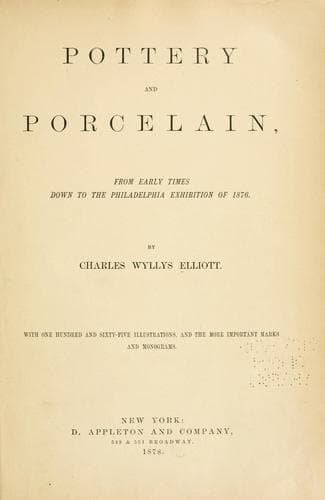
Pottery and Porcelain, from early times down to the Philadelphia exhibition of 1876Elliott, Charles Wyllys
History
Pottery and Porcelain, from early times down to the Philadelphia exhibition of 1876
Elliott, Charles Wyllys
Pottery -- History; Pottery -- Marks
The Kioto is a faience of a weaker body than the Satsuma, and running
more to a lemon-yellow. Its decoration is marked by a certain delicacy
which in small articles is good, but which in large ones lacks strength.
Shimzi, of Kioto, had a case of good pieces.
Meyagama, of Yokohama, had some delightful porcelain vases, decorated in
relief with butterflies, plants, etc., which, it is satisfactory to
know, were bought by our New York friends.
The case of old wares shown by Kiriu Kosho Kuwaisha, from Tokio,
contained a collection which had a kind of mysterious fascination even
to us "outside barbarians," which we suppose might have become an
intense desire to possess, could we have known anything about them.
CHAPTER XII.
THE PORCELAINS OF CENTRAL EUROPE--DRESDEN, BERLIN, HÖCHST, ETC.
Dresden China.--Porcelain in Europe.--The Alchemists.--Augustus
II.--Böttger.--Tschirnhaus.--Experiments.--Kaolin
discovered.--Höroldt and Kändler.--Fine Art, or Decorative
Art.--Lindenir.--Angelica
Kauffmann.--Rococo-Work.--Collectors.--Marcolini.--Prices.--Marks.
--Berlin.--The Seven Years' War.--Frederick the Great.--Prices.
--Marks.--Vienna.--Stenzel.--Maria Theresa.--Lamprecht.--Prices.
--Marks.--Hungary.--Herend.--Fischer.--Marks.--Höchst, or Mayence.
--Ringler.--Marks.--Frankenthal, or Bavarian.--Carl Theodor.--Melchior.
--Prices.--Marks.--Fürstenburg, or Brunswick.--Von Lang.--Prices.--Marks.
--Nymphenburg.--Heintzmann and Lindemann.--Prices.--Marks.--Ludwigsburg,
or Kronenburg.--Fulda.--Hesse-Cassel.--Switzerland.--Marks.
In this chapter I wish to give some comprehensive account of the famous
porcelain of Dresden, which in Europe first came into prominence, and
kept its place for so long a time. With this the other manufactories of
Central and Eastern Europe will be grouped, for convenience rather than
for the purposes of classification. We will take a comprehensive survey
of--
1. Dresden, Meissen, or Saxony (it has all these names).
2. Berlin, or Prussian.
3. Vienna and Hungary.
4. Höchst, or Mayence.
5. Fürstenburg, or Brunswick.
6. Frankenthal, or the Palatinate.
7. Nymphenburg.
8. Kronenburg.
9. Fulda.
10. Limbach.
11. Switzerland, etc.
We are apt to think that the mental force of Europe, down to very recent
days quite into the last century, was directed almost wholly to the
science and the practice of war. A great force certainly was so
exhausted; but there was also, after the Renaissance (A. D. 1200 to
1300), a powerful stream turned upon literature, science, art, and
religion. The alchemists, in their searchings for the secret of
happiness--for the changing of baser things to gold--in their hunt for
the fountain of perennial youth, were all chemists; and out of their
(what we are pleased to term) "visionary notions" came many discoveries
most curious and valuable to man.
Public-domain text, read in full here on John Shaqi.
Reviews
Reviews
No reviews yet
Be the first to share your thoughts on this work.
Elsewhere in the archive
Join the Discussion
Join the discussion
Sign in to leave a comment or review.
Sign InorCreate an account