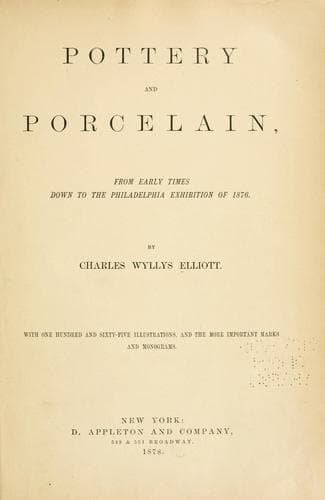
Pottery and Porcelain, from early times down to the Philadelphia exhibition of 1876Elliott, Charles Wyllys
History
Pottery and Porcelain, from early times down to the Philadelphia exhibition of 1876
Elliott, Charles Wyllys
Pottery -- History; Pottery -- Marks
When, in 1518, the Portuguese introduced fine Oriental porcelains into
Europe, and, after them, the Dutch brought by ship-loads the beautiful
productions of China and Japan, they were spread over Europe like water
passing its dikes. Every king, every noble, every man of taste, was
touched as by a fairy wand, and became inspired with a desire of
possession, and also with a wish to create such articles of use and
beauty. But the secrets of porcelain were locked in the souls of those
keen Orientals, who would not part with their knowledge.
Still the chemists, the alchemists, of Europe were at work, peering with
curious eyes into the composition of the most exquisite of fictile ware.
The paste, the glaze, the ornament--all were of profound interest.
Pottery of various kinds had been made in Europe from the earliest
times, but no porcelain.
How could the superior European compete with or equal the inferior
Mongol? A hard question.
For a long time it has been believed that the earliest European
production of porcelain was in Saxony, about the years 1710 to 1715. But
within a late period it has been found that porcelain--soft paste--was
discovered and made in Florence as far back as 1575 to 1587, under the
direction and patronage of Francesco I. (de' Medici), the Grand-duke of
Tuscany. No great quantities were made, and but few pieces of it exist
now, of which we may treat hereafter.
The porcelain of Dresden is also called Saxon and Meissen; Dresden being
the capital of Saxony, and Meissen the village, some twelve miles from
Dresden, where the factories are established.
How were they established, and why?
Augustus II., Elector of Saxony, and afterward by election King of
Poland, born in 1670, was a man of expensive habits and luxurious
tastes. While a young man he visited Italy and other countries, always
indulging these tastes by the purchase of pictures and other works of
art. The beautiful porcelains of China and Japan, then rare in Europe,
interested him, and he became of course a collector; and so he continued
through his luxurious and troublesome life. That I cannot write; it may
only be said that he combined with Peter the Great and with Denmark to
drive out and keep out of his part of Europe that enterprising and
indefatigable fighter, Charles XII. of Sweden, and was himself utterly
routed and driven from Poland in 1704. He still retained the throne of
Saxony, to which his son succeeded. This elector inherited the tastes
and habits of his father, and continued to encourage and support the
manufactory of porcelain at Meissen, until, entangling himself with
Maria Theresa of Austria in an alliance against Frederick the Great,
that restless and irresistible king overran his country, and for a time
destroyed the production of porcelain in Saxony (A. D. 1756).
Public-domain text, read in full here on John Shaqi.
Reviews
Reviews
No reviews yet
Be the first to share your thoughts on this work.
Elsewhere in the archive
Join the Discussion
Join the discussion
Sign in to leave a comment or review.
Sign InorCreate an account