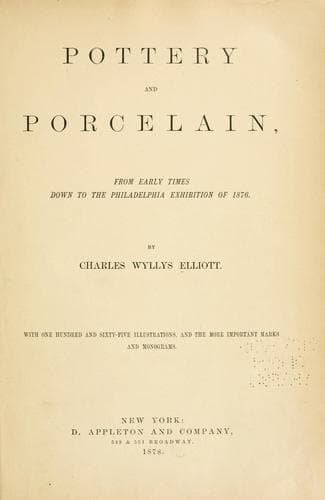
Pottery and Porcelain, from early times down to the Philadelphia exhibition of 1876Elliott, Charles Wyllys
History
Pottery and Porcelain, from early times down to the Philadelphia exhibition of 1876
Elliott, Charles Wyllys
Pottery -- History; Pottery -- Marks
Assuming that the Orientals are races who perceive or feel, rather than
reason--while the reverse of this is true of Europeans and Americans--we
find our art often losing its way, which that of the Orientals seldom
does. The natural or instinctive soul, by its native sense, is guided in
matters of color and decoration more truly than we who attempt to reason
out these things. Now, applying this to the facts of fictile art, we
find that the Chinese and Japanese never attempted figure-work in
porcelain, except in some few cases of burlesques, or of animals and
birds. Their work was applied to that which comes into the uses of
life--for the table first and mostly; after that for vases, which became
works of pure ornament, but yet behind which lay the motive of _use_. In
all this, it seems to me, the Orientals were right, and the Saxons
wrong.
I believe, then, that the best and purest art will be found in porcelain
when applied to the decoration of dinner and tea services, of vases, and
of articles which do not attempt to rival sculpture or high art; and
those may reach perfection, while the porcelain sculptures will not.
I believe, too, that the best style of decoration for porcelain is not
imitative, but suggestive--that is, an elaborate and careful _copy_ of a
flower or a figure upon the clay is not so appropriate or so
satisfactory as a free translation of the sentiment of the flower or the
figure, which suggests it to the soul rather than tickles the eye.
It is not appropriate, so it seems to me, that a delicate painting of a
beautiful girl should be made on the dinner-plate upon which you are to
put your squash or your pudding; such delicate penciling should be
devoted to art pure and simple--to "fine art," as it is called. Such
paintings on china cannot be put to use; they are too costly, and
therefore they fail to be either useful art or fine art.
Now, the tendency of European porcelain-decoration is always in this
"fine-art" direction, and is always false; that of Oriental porcelain is
always in the useful-art direction, and therefore true.
The pure white porcelain of Meissen was not at first sold, but was
reserved for the king's use, or for presents to distinguished
personages. In later times it was sold, and is still; and the pieces so
disposed of have a _scratch_ cut across the _mark_, to indicate that
they were not painted in the factory.
The works at Meissen grew in importance and in public favor up to the
time of the Seven Years' War (1756 to 1763), when Frederick the Great
overran Saxony, broke up the Meissen factory, and removed the workmen to
Berlin, where he established the Prussian potteries, which afterward
came to be of great consequence.
Public-domain text, read in full here on John Shaqi.
Reviews
Reviews
No reviews yet
Be the first to share your thoughts on this work.
Elsewhere in the archive
Join the Discussion
Join the discussion
Sign in to leave a comment or review.
Sign InorCreate an account