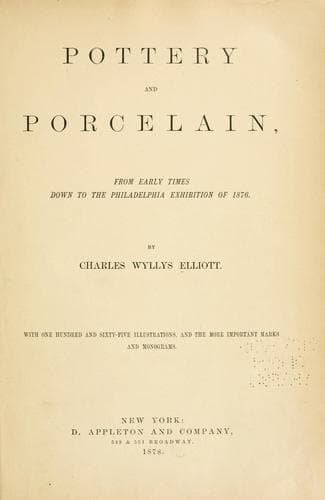
Pottery and Porcelain, from early times down to the Philadelphia exhibition of 1876Elliott, Charles Wyllys
History
Pottery and Porcelain, from early times down to the Philadelphia exhibition of 1876
Elliott, Charles Wyllys
Pottery -- History; Pottery -- Marks
The production of hard porcelain at this period had become a matter of
importance; for it was well known that at Dresden most finished work of
this kind had for a long time been made. Soft porcelain, though equally
or more beautiful, was difficult to make, was then expensive, and lacked
the strength and durability of the hard. Hard porcelain or _pâte dure_,
was the one thing desired. But this could not be made without the
peculiar clay called kaolin, which the Saxons had, but which they would
not allow the French to get. This was not obtained, as has been said,
till 1765, and from that time Sèvres entered upon a period of production
which has had no equal in Europe.
The buildings were ample, the gardens were pleasant, and the interest in
the production of the royal works may be appreciated from the fact that
the king, accompanied by Madame de Pompadour, made weekly visits, to see
that all went well. And all did go will. No money was wanting; artists
of the highest rank were enlisted; skilled men of every kind contributed
their knowledge and keenness to bring the delicate work to perfection.
Madame de Pompadour, herself an artist in her way, not only came weekly
to enjoy the work of others, but she often applied her own hands to
making designs, or to touching or perfecting what fine thing might be
going forward. Under such stimulus as this it was inevitable that every
modeler, every artist, every colorist, should be inspired to do his
best. They were patronized by royal hands which disposed of all the
glory and wealth of France.
Painters having a wonderful technical skill were eagerly engaged, and
much of the work done has the merit--not the highest one, certainly--of
being most delicately and elaborately penciled. No work of this kind
ever has surpassed what was done on the vases, teacups, écuelles, etc.,
made at Sèvres. The variety of decoration upon these elaborate pieces
was great, comprising among others, birds, flowers in wreaths and
garlands, and bouquets, landscapes, figures, arabesques, Cupids,
emblems, cameos, masks, miniatures, Watteau pictures, children, pastoral
subjects, Chinese and Japanese imitations, butterflies, medallions,
sea-pieces, insects, etc.: the whole of Nature and art was ransacked for
interesting and attractive material.
Almost or quite all of this may be characterized as most clever
imitation, exquisitely painted. Even the artists who were inspired by
love of Oriental work seem to have imitated or copied that; they did not
learn by it how to express Occidental life and growth, in their own
individual way, and with that piquant fresh touch which marks so much
of the best Oriental work. Nevertheless, it is exquisite, and conveys a
sense of satisfaction and completeness because of that, even to those
who do not approve of it as the best decorative art.
Public-domain text, read in full here on John Shaqi.
Reviews
Reviews
No reviews yet
Be the first to share your thoughts on this work.
Elsewhere in the archive
Join the Discussion
Join the discussion
Sign in to leave a comment or review.
Sign InorCreate an account