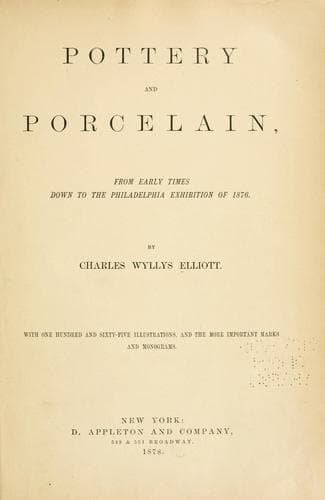
Pottery and Porcelain, from early times down to the Philadelphia exhibition of 1876Elliott, Charles Wyllys
History
Pottery and Porcelain, from early times down to the Philadelphia exhibition of 1876
Elliott, Charles Wyllys
Pottery -- History; Pottery -- Marks
SÈVRES.--We cannot to-day appreciate the enthusiasm which existed at
this period (1750) in France, as well as in many other states of Europe,
upon the subject of porcelain manufacture. Among royal and noble people
it was peculiarly strong. The kings of France were always open to the
projects of experts, who promised to produce wonderful results; and, in
1745, when the company was formed to produce porcelain at Vincennes, the
king, Louis XV., contributed to the capital the sum of one hundred
thousand livres.
Madame de Pompadour, at this period the most beautiful woman and the
most influential personage in France, was an eager patron of the ceramic
arts, and gave all her influence to promote their development; the
queen, too, was greatly interested; we may be sure that all good
courtiers followed their lead. About this time (1740 to 1750) a
wonderful production of porcelain flowers was in vogue at Vincennes, and
the most elaborate work was done there, so that two bouquets made for
the king and dauphine cost them the great sum of three thousand livres
(francs) each; which was a great deal more than three thousand francs is
now. A single order given by the king amounted to the sum of eight
hundred thousand livres. This attempt to _imitate_ flowers in colored
porcelain we now consider foolish, as well as false art; and very
properly it has passed away as one of the whimsies of the time. Some of
these flowers, such as double ranunculuses, orange-flowers, anemones,
etc., still remain, wonders of fictile work, in the Musée Céramique, at
Sèvres.
But the porcelain-works at St.-Cloud and Vincennes, the _avant couriers_
of Sèvres, produced many other and more legitimate objects of use as
well as art. The dinner and tea services made here were most elaborate
and costly; one made for the Empress of Russia was decorated with
paintings of antique cameos, and the cost was some three hundred and
sixty thousand livres, a vast sum surely.
At certain seasons the courtiers were expected to purchase the work of
the royal factory, and presents were sent hither and thither; so that
for a time the manufactory not only enjoyed the favor of the king, but
also the sunshine of the court.
In 1748 a superb vase was made and presented to the queen. It stood on a
bronze pedestal, and was about three feet high. The marvelous part of it
was the great bouquet it contained, which consisted of four hundred and
eighty porcelain flowers exquisitely modeled and colored after Nature.
The mark used at Vincennes will be given with those of Sèvres.
In 1756 the porcelain-works of Vincennes were removed to Sèvres, and
from that period everything possible was concentrated there; and in 1759
or 1760 the whole came under the control and direction of the king. We
see, therefore, how out of the efforts at St.-Cloud and Chantilly and
Vincennes the works at Sèvres at last grew up. All was now combined at
Sèvres.
Public-domain text, read in full here on John Shaqi.
Reviews
Reviews
No reviews yet
Be the first to share your thoughts on this work.
Elsewhere in the archive
Join the Discussion
Join the discussion
Sign in to leave a comment or review.
Sign InorCreate an account