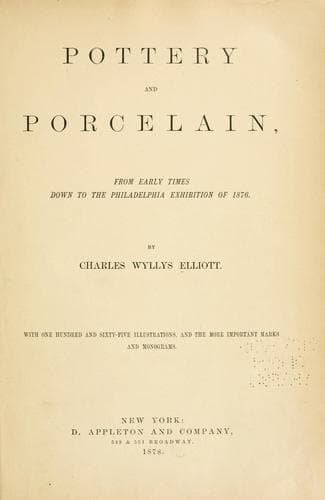
Pottery and Porcelain, from early times down to the Philadelphia exhibition of 1876Elliott, Charles Wyllys
History
Pottery and Porcelain, from early times down to the Philadelphia exhibition of 1876
Elliott, Charles Wyllys
Pottery -- History; Pottery -- Marks
"A discovery of some curiosity and interest in connection with the
history of the manufacture of porcelain in Southern Europe has recently
been made by the acumen of Dr. Foresi, of Florence, and which has the
effect of antedating the manufacture by at least a century. Before this
discovery the fabrique at St.-Cloud, in France, was the earliest that
could be authenticated. This was about the year 1695; but the facts now
brought forward prove the existence of a factory for the manufacture of
a true porcelain at Florence, under the patronage of the Grand-duke
Francis I., about the years 1580 to 1590. For some time the doctor had
observed a peculiar ancient porcelain of a fine body and glaze, and
covered with an arabesque ornament in blue, which, while it generally
resembled Oriental porcelain, showed unmistakable features of European
design. It was also marked in a peculiar manner, and, as one mark
consisted of the well-known pellets of the Medici family arms, he was
induced to search the records of the house, and, to his surprise,
found--what had been overlooked by all historians of the potter's
art--that the duke above named had attached to his well-known laboratory
in the Boboli Gardens a small manufactory of porcelain. By continuing
his researches he at last exhumed a manuscript from the Magliabecchian
Library, which had been compiled by some person employed by the duke,
and which also detailed the facts connected with the composition of the
ware."
This manufacture continued from 1575 to 1587.
THE MEDICI.--The history of this remarkable family of the Medici can
never fail to interest. Roscoe has presented it well in his "Life of
Lorenzo the Magnificent," etc. The origin of the family is very vague;
but the fact is well known that the founder of its greatness was
Giovanni de' Medici (he died 1429), who, instead of grasping states and
principalities with one hand, while the other held the glittering sword,
as had for so long a time been the fashion, seized upon the great trade
which then had sprung up between the Occident and the Orient, and which
became vast and profitable in the hands of the merchants of Florence,
Genoa, and Venice.
This trade poured ducats into his coffers like the flow of a river, and
when he died he left vast stores of gold to his sons Cosmo and Lorenzo.
Public-domain text, read in full here on John Shaqi.
Reviews
Reviews
No reviews yet
Be the first to share your thoughts on this work.
Elsewhere in the archive
Join the Discussion
Join the discussion
Sign in to leave a comment or review.
Sign InorCreate an account