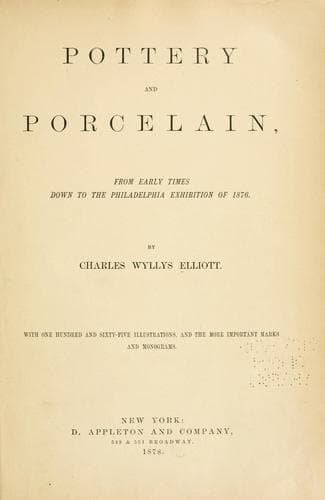
Pottery and Porcelain, from early times down to the Philadelphia exhibition of 1876Elliott, Charles Wyllys
History
Pottery and Porcelain, from early times down to the Philadelphia exhibition of 1876
Elliott, Charles Wyllys
Pottery -- History; Pottery -- Marks
It is for these reasons, rather than for its intrinsic beauty, that most
English porcelain is so eagerly desired. It is not generally remarkable
for perfection of form or of paste, or for originality or beauty of
color and ornament; but in some cases all of these are to be found. The
early paste of the older factories, such as Bow and Chelsea, is
considered inferior to the best Chinese and Japanese, and to the early
Dresden and Sèvres. Afterward the paste was greatly improved, until now
that made at the porcelain-works at Worcester, and at some other of the
English factories, is not surpassed anywhere. It seems to me that the
English modelers have not cultivated that sense of perfection of form
and grace of line which was so wonderful in Greece, and in which the
French modelers excel the English. It may be that the desire for
strength, which seems to inspire most English porcelain, has demanded
the sacrifice of that delicacy, thinness, and niceness, which have for a
long time prevailed in France. But the English porcelain is noted for
its strength and wearing quality; it is certainly superior in this
respect to most of the French work.
Whoever has interest enough in the subject should visit, when in
England, the porcelain-works at Worcester, now conducted by Mr. Binns.
Here he can see all the processes going on, by means of which the teacup
and the dinner-plate are brought to perfection. It is not a simple
matter. Several kinds of clays are to be got together--some from
England; some, perhaps, from elsewhere. These are ground to such an
impalpable fineness that they are floated away in water, and are allowed
to settle into tanks, from which, when in the right condition, they are
taken to the moulder for use. The collecting, the mixing, the grinding
of these clays is the result of much brain and hand work--a great deal
more than most men are obliged to use in getting into Congress or
Parliament, or in writing a book.
As the dexterous potter moulds upon his wheel the forms of the Greek
amphora or the Chinese teacup, they seem to spring under his hand as if
touched by the fairy's wand.
I think no one can see this work grow without a feeling of surprised
pleasure; and, after witnessing it, no one can fail to have a greater
satisfaction at seeing and using the various objects of use and beauty,
to be found now in every house--a satisfaction increased by knowledge.
Even in the ordinary mug or jug which costs a sixpence, are often to be
detected great knowledge, much art. We do not give the workman half his
due when we fail to feel how much we owe to him. An eye to see the
beautiful, the good, the true, is to be prayed for.
When the turner and modeler has perfected his pot, it has to go through
its firings, glazings, paintings, until it comes to us a perfected work,
which we too often hardly look at. It is only a jug!
Public-domain text, read in full here on John Shaqi.
Reviews
Reviews
No reviews yet
Be the first to share your thoughts on this work.
Elsewhere in the archive
Join the Discussion
Join the discussion
Sign in to leave a comment or review.
Sign InorCreate an account