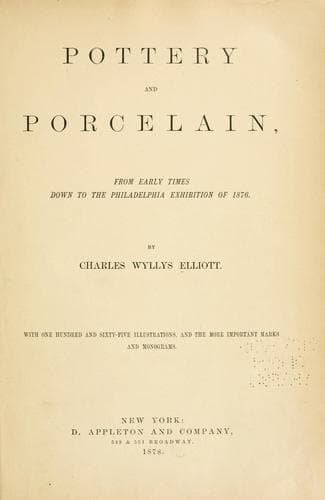
Pottery and Porcelain, from early times down to the Philadelphia exhibition of 1876Elliott, Charles Wyllys
History
Pottery and Porcelain, from early times down to the Philadelphia exhibition of 1876
Elliott, Charles Wyllys
Pottery -- History; Pottery -- Marks
There is more than the money's worth in every good piece of
cabinet-work, iron-work, woven fabric, etc.; for with every honest
workman's hand goes a part of his soul: he gives it willingly, gladly.
BOW--SOFT PASTE.--The small village of Stratford-le-Bow, in Middlesex,
now, I think, a part of London, is believed to be the place where a
china-factory was first established in England, and some suppose it may
have been as early as 1730, though 1744 is the earliest authentic date
mentioned. Mr. Chaffers[15] says--and it has some interest to us
Americans, as perhaps showing whence the old and great England drew its
first porcelain life--"William Cookeworthy, of Plymouth, writing to a
friend in 1745, says: 'I had lately with me the person who has
discovered the _china-earth_. He had with him several samples of the
china-ware, which I think were equal to the Asiatic. It was found on the
back of Virginia, where he was in quest of mines; and having read Du
Halde, he discovered both the _petunze_ and _kaolin_. It is this latter
earth which he says is essential to the success of the manufacture. He
is gone for a cargo of it, having bought from the Indians the whole
country where it rises. They can import it for thirteen pounds sterling
the ton,'" etc.
It seems probable or possible that this earth was used to some extent in
the earlier productions at Bow, as it is mentioned in the application of
the company for patents, and as it appears that some hard porcelain is
found among the earlier examples existing, in which this kaolin was
perhaps used--called by the natives "unaker."
The enterprise at Bow was purely a private one, originating with Edward
Heylin, a merchant, and Thomas Frye, a painter. Unlike the works at
Meissen, Sèvres, and indeed many others on the Continent, none of the
factories in England had the assistance of the Government. The Bow works
were afterward carried on by Crowther and Weatherby. In the British
Museum is a large punch-bowl, made at Bow and painted by Thomas Craft,
which is accompanied with his certificate. This statement shows that the
works at Bow at that time (1760) had become extensive, if not
profitable, for he mentions, "They employed there three hundred persons;
about ninety painters (of whom I was one), and about two hundred
turners, throwers, etc."
The examples existing, and recently-discovered documents, go to show
that the paste or body at Bow was not of supreme excellence, and not at
all equal to that made on the Continent at that time. The painting was
in a variety of designs, as appears by some memorandum-books, still
existing: "Blue Newark pattern," "sets of blue teas," "a
dinner-service," "blue and pale as you please." Tea-sets were evidently
much made, and "white bud-sprigs," "sprigged tea-sets," and "Dresden
sprigs," are mentioned.
While all the first work at Bow was hand-painted, it appears that later,
about 1756, printed or transfer work was used there; this, of course,
secured cheaper sets.
Public-domain text, read in full here on John Shaqi.
Reviews
Reviews
No reviews yet
Be the first to share your thoughts on this work.
Elsewhere in the archive
Join the Discussion
Join the discussion
Sign in to leave a comment or review.
Sign InorCreate an account