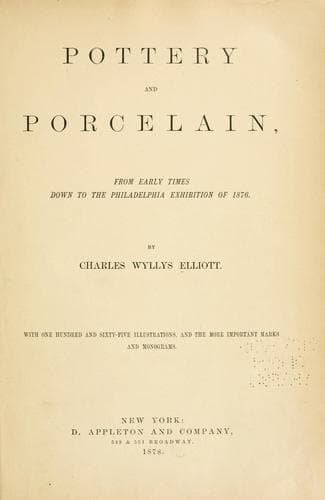
Pottery and Porcelain, from early times down to the Philadelphia exhibition of 1876Elliott, Charles Wyllys
History
Pottery and Porcelain, from early times down to the Philadelphia exhibition of 1876
Elliott, Charles Wyllys
Pottery -- History; Pottery -- Marks
[Illustration: _Used down to 1793._]
[Illustration: _Used by Dr. Wall._]
[Illustration: _Imitation Chinese._]
[Illustration: _Imitation Oriental._]
[Illustration: _Imitation Oriental._]
[Illustration: _Imitation Dresden._]
[Illustration: _Imitation Dresden._]
[Illustration: _Imitation Dresden._]
[Illustration: _Messrs. Flight (1783 to 1788)._]
[Illustration: _Flight and Barr (1793 to 1807)._]
[Illustration: _Barr (1793 to 1803)._]
[Illustration: _Barr, Flight and Barr (1807 to 1818)._]
The marks used at the present time at Worcester (1876) are as follows:
[Illustration: _In use since 1852._]
[Illustration: _In use since 1857._]
CHAMBERLAIN'S--WORCESTER.--In 1786 Robert and Humphrey Chamberlain began
a porcelain-factory at Worcester. Robert had learned the business in the
old Worcester works, and was an accomplished man. Some splendidly-decorated
porcelain was made by them; and a breakfast-set, made for Lord Nelson,
is quite famous. Pieces of it are found in collections. The Chamberlains
employed the best painters, and paid high wages. Their expensive work
was made rich with much gold.
A dessert-service in the possession of Mr. W. C. Prime, of New York,
shows this, and is brilliant and effective. We engrave one of the plates
(Fig. 152). The birds are tropical, and fine in color, and the plants
are bordered with gold. The Chamberlains' factories are now incorporated
with the "Worcester Company," under the charge of Mr. Binns.
The Chamberlains' first mark was the name "Chamberlain," written with a
brush in a running hand. Afterward a stamp was used, containing a crown
and the names "Chamberlain and Company," and Worcester. Then the names
simply of
CHAMBERLAIN,
WORCESTER.
Marks of Chamberlain porcelain:
[Illustration]
[Illustration]
[Illustration]
PLYMOUTH--HARD PORCELAIN.--The first true or hard-paste porcelain made
in England was made by William Cookworthy, who, being greatly interested
in porcelain-making, established a factory at Plymouth about 1760. He
seems to have discovered the true kaolin clays in Cornwall, the beds
from which so much of the English clays are now taken. He took out
patents for "a kind of porcelain newly invented, composed of Moorstone
or growan, and growan clay," found in Devon and Cornwall. He advertised
for painters, and a Frenchman named Soqui seems to have been very
skillful. Bone, also, was one of his best painters. The ware made was
perfect hard porcelain, but it was much more costly than the ordinary
soft porcelain of England, and could not compete with it for price. Many
of the pieces were warped or crazed in the strong heat necessarily used,
and the loss in this way was great. Besides this, the good public did
not care to pay high for what then had no prestige, and was really no
more beautiful than the soft-paste porcelain of England. As the _first_
hard-paste porcelain made in England, and as but little of it was made,
it is now valued by china-collectors, and it sells for high prices.
Public-domain text, read in full here on John Shaqi.
Reviews
Reviews
No reviews yet
Be the first to share your thoughts on this work.
Elsewhere in the archive
Join the Discussion
Join the discussion
Sign in to leave a comment or review.
Sign InorCreate an account