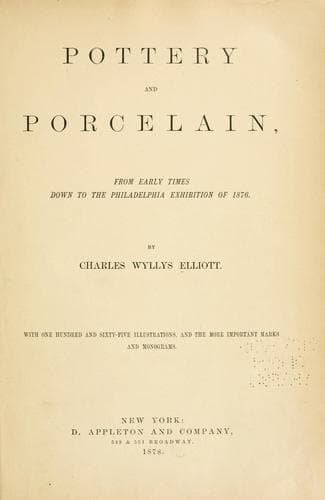
Pottery and Porcelain, from early times down to the Philadelphia exhibition of 1876Elliott, Charles Wyllys
History
Pottery and Porcelain, from early times down to the Philadelphia exhibition of 1876
Elliott, Charles Wyllys
Pottery -- History; Pottery -- Marks
Thus, from that early day, a great love for fine porcelain has existed
in the "Low Countries"--what we now know as Holland and Belgium. At the
present time no field bears a better yield for the gleaner who seeks
fine examples of old porcelain, and especially of the Oriental, than
these countries. Thousands upon thousands of porcelains were imported
into Holland after the year 1640, whence they were distributed over
Europe. But Holland could not hold her monopoly of trade; France and
England sought to grasp it, too, and England succeeded. During the last
century England has steadily drawn the trade of the East to herself, and
Holland has lost what England has gained.
In the many changes consequent upon this, many stores of good porcelain
gathered in Holland have gradually come to be sold to persons who wanted
them more than the Dutch did.
Out of this great trade with the Orientals it is easy to see that the
Dutch should come to be connoisseurs and lovers of porcelain. It is also
easy to see that a sufficient interest should spring up there, after the
discovery of true porcelain at Dresden, to induce persons to attempt the
manufacture in Holland. This was stimulated during the Seven Years' War,
when the works at Meissen (Dresden) were closed, and for a time broken
up. Then in Holland, as well as in other countries of Europe, there was
an opportunity. The love for porcelain had grown great after the
discoveries at Dresden, and the demand for it was vastly increased. The
disturbances in Saxony, amounting to prohibition of the manufacture,
gave other countries a possible chance to compete with the advantages
of Saxony, which otherwise were overwhelming. Still, in Holland no great
commercial success was reached. In none of these northern countries has
the making of fine porcelain been an assured success. This is owing to
many causes, among which we may point to--
1. The genius of the people does not impel them.
2. The clay and the wood and the coal are not at their doors.
3. Other nations have taken the lead and driven them from the markets of
the world, sometimes from their own.
In the Low Countries we may mention as places where the manufacture was
attempted--with, however, only a fictile life: Weesp, Loosdrecht,
Arnheim, Amsterdam, Amstel--old and new--The Hague, Tournay, Brussels,
Luxemburg, Lille (now in France).
WEESP--HARD PASTE.--The first effort was made at Weesp, not far from
Amsterdam, about 1764, during the Seven Years' War. For a short time,
until 1771, fine and white porcelain was made here, but not in great
quantities, and the attempt was not a commercial success.
The marks were:
[Illustration]
At LOOSDRECHT (HARD PASTE), not far from Utrecht, De Moll began a small
factory in 1772. He made a fine quality of china, closely following the
Dresden. It had but a short existence. His mark was "M o L.," meaning
_Manufactur oude Loosdrecht_.
Public-domain text, read in full here on John Shaqi.
Reviews
Reviews
No reviews yet
Be the first to share your thoughts on this work.
Elsewhere in the archive
Join the Discussion
Join the discussion
Sign in to leave a comment or review.
Sign InorCreate an account