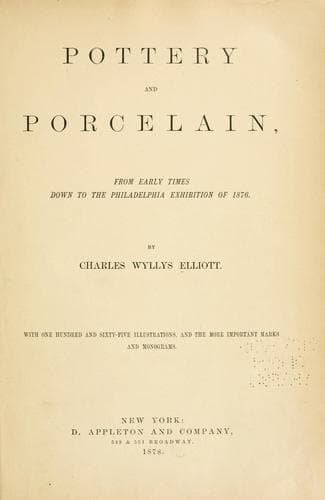
Pottery and Porcelain, from early times down to the Philadelphia exhibition of 1876Elliott, Charles Wyllys
History
Pottery and Porcelain, from early times down to the Philadelphia exhibition of 1876
Elliott, Charles Wyllys
Pottery -- History; Pottery -- Marks
The use of glaze and of tin to form the glaze or enamel seems to have
been known to the Chinese beyond the time when Occidental records were
kept. It appears, according to Sir Gardiner Wilkinson and Mr. Samuel
Birch, that very early indeed the Egyptian potters knew the use of the
siliceous glaze, composed of sand and potash or soda; and also that
small sepulchral figures have been found, coated with enamels made from
oxides of tin or copper, dating as far back as the sixth dynasty (B. C.
3703). In the museums of Europe are preserved tiles and bricks taken
from the temples or palaces of Egypt and Babylon, and they must have
been largely used long before our historical time. These glazed bricks
are supposed to date back twenty-five hundred years before our era.
Mr. Birch, in his "History of Ancient Pottery," says that the use of
these bricks was probably learned by the Assyrians from the Egyptians,
"who at a very early period had inlaid in this manner the chamber of the
Pyramid at Saqquara."
He says: "The glazed or enameled bricks from Nimrúd are of the usual
kiln-dried kind, measuring thirteen and a half inches square, and about
four and a half inches thick. They were laid in rows horizontally above
the slates of sculpture of the Mosul marble, and seem to have been
employed in the construction of cornices. They are glazed on one of the
narrow sides or edges only, having on this edge various patterns,
chiefly of an architectural nature, such as guilloche or chain
ornaments, bands of palmettes or helices, and fleurettes or flowers of
many petals. The colors employed were blue, black, yellow, red, and
white. The glaze, which is much decomposed, easily exfoliates, and the
colors have lost much of their freshness. It would appear that patterns
of tolerably large size were executed in this manner, each brick having
its appropriate portion enameled upon it.... Another brick, found by Mr.
Layard in the earliest palace of Nimrúd, has an horizontal line of
inscription in arrow-headed characters of a darker color, and with
square heads like nails. Its tenor was of the usual purport: 'This is
the great palace of "Asar-aden-pal."' Bricks of this glazed kind were
found chiefly in the space between the great bulls which flanked the
entrances of the chambers. From Nimrúd were also brought corbels of blue
faience, or what has been called porcelain, the under part modeled to
represent the five fingers of the hand."
Public-domain text, read in full here on John Shaqi.
Reviews
Reviews
No reviews yet
Be the first to share your thoughts on this work.
Join the Discussion
Join the discussion
Sign in to leave a comment or review.
Sign InorCreate an account