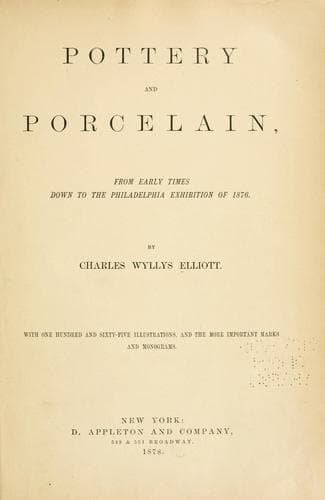
Pottery and Porcelain, from early times down to the Philadelphia exhibition of 1876 — John Shaqi
Pottery and Porcelain, from early times down to the Philadelphia exhibition of 1876Elliott, Charles Wyllys
History
Pottery and Porcelain, from early times down to the Philadelphia exhibition of 1876
Elliott, Charles Wyllys
Pottery -- History; Pottery -- Marks
Between China and the Spanish Moors exist a wide gap and centuries of
time, in which glazed pottery and porcelain intended for the uses of
domestic life seem to have been unknown. And this, too, was among the
Greeks, the Phoenicians, the Romans--nations eager for every good
thing, astute, keen, grasping. Among the remains of Roman art have been
found a few pieces of pottery upon which are traces of the use of a
glaze; but, if it was used at all, it seems to have been almost an
accident--not at all as with us, to complete and perfect the work.
To the Moors and the Moorish civilization of Spain, Europe owes the
knowledge or the introduction of this most valuable art, which has
enabled her to reach such perfection in the making of fictile ware as we
now see and enjoy.
Not only has the glaze (and enamel) given great strength to pottery, and
increased its use to an infinite variety: it has also enabled most
nations, beginning with the Chinese, to add to its beauty, and, indeed,
to develop or create a method of artistic expression which is peculiar
and most interesting. This subject will be treated more fully, in the
progress of this work, in a chapter upon decorating porcelain and
pottery.
After the work of the Moors in Spain, which will be treated in a
separate chapter, one of the earliest applications of the glaze in
Europe was upon a hard sort of _stone-ware_ made at various places along
the Rhine, and in Flanders and Germany. It has come to be known under a
generic title of GRÈS DE FLANDRE, while but little of it was really made
in Flanders. A great centre of its manufacture and sale, as early as the
1300's of our era, was at Cologne; and a more fit name for it would be
Grès de Cologne; still, the usual name is the one the world knows it by.
The body or paste of which this is composed differs from the faiences or
earthen-wares of which we write.
It is harder, heavier, and much more durable. The commoner kinds are
made so by a considerable mixture of siliceous sand; while in the finer
kinds, known as Grès de Flandre, there are mixed with the paste other
clays, such as _terre de pipe_ and _kaolin_. This hard and heavy body
has long been used for common stone-ware jugs and pots made for
every-day use. In China it was and is still used as a body for vases and
dishes, which received a covering or "engobe," and upon that an artistic
finish--such as the crackle-vases, and many others.
The glaze upon what we know as Grès de Flandre was made by using in the
furnace common salt; the fumes of which, combining with the fused silex,
resulted in what is termed the _salt-glaze_. This requires a high degree
of heat, in which no colors will stay except the blue of cobalt, a
brown, and a violet.
Public-domain text, read in full here on John Shaqi.
Reviews
Reviews
No reviews yet
Be the first to share your thoughts on this work.
Join the Discussion
Join the discussion
Sign in to leave a comment or review.
Sign InorCreate an account