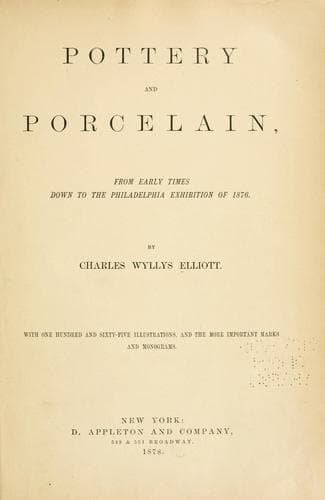
Pottery and Porcelain, from early times down to the Philadelphia exhibition of 1876Elliott, Charles Wyllys
History
Pottery and Porcelain, from early times down to the Philadelphia exhibition of 1876
Elliott, Charles Wyllys
Pottery -- History; Pottery -- Marks
"Chiefly under the direction of one man, it would seem that the produce
of the Gubbio furnaces was for the most part of a special nature;
namely, a decoration of the pieces with the lustre-pigments, producing
those brilliant metallic-ruby, golden, and opalescent tints which vary
in every piece, and which assume almost every color of the rainbow as
they reflect the light directed at varying angles upon their surface.
That the Gubbio ware was of a special nature, and produced only at a few
fabriques almost exclusively devoted to that class of decoration, is to
be reasonably inferred from Piccolpasso's statement, who, speaking of
the application of the maiolica-pigments, says, '_Non ch'io ne abbia
mai fatto ne men veduto fare._' He was the maestro of an important
botega at Castel-Durante, one of the largest and most productive of the
Umbrian manufactories, within a few miles, also, of those of Urbino,
with which he must have been intimately acquainted and in frequent
correspondence. That he, in the middle of the sixteenth century, when
all these works were at the highest period of their development, should
be able to state that he had not only never applied or even witnessed
the process of application of these lustrous enrichments, is, we think,
a convincing proof that they were never adopted at either of those seats
of the manufacture of enameled pottery. Although much modified and
improved, lustre-colors were not invented by Italian artists, but were
derived from the potters of the East, probably from the Moors of Sicily,
of Spain, or of Majorca. Hence (we once more repeat) the name 'majolica'
was originally applied only to wares having the lustre enrichment; but,
since the decline of the manufacture, the term has been more generally
given: all varieties of Italian enameled pottery being usually, though
wrongly, known as 'maiolica.'
"That some of these early _bacili_, so well known, and apparently the
work of one artist, were made at Pesaro, whence the secret and probably
the artist passed to Gubbio, is far from improbable. The reason for this
emigration is not known, but it may be surmised that the large quantity
of broom and other brush-wood necessary for the reducing process of the
reverberatory furnace in which this lustre was produced might have been
more abundantly supplied by the hills of Gubbio than in the vicinity of
the larger city on the coast. That the process of producing these
metallic effects was costly, we gather from Piccolpasso's statement that
sometimes not more than six pieces out of a hundred succeeded in the
firing.
Public-domain text, read in full here on John Shaqi.
Reviews
Reviews
No reviews yet
Be the first to share your thoughts on this work.
Elsewhere in the archive
Join the Discussion
Join the discussion
Sign in to leave a comment or review.
Sign InorCreate an account