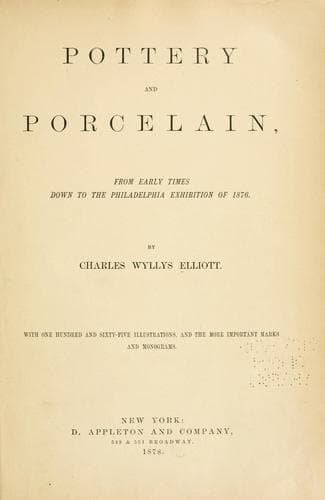
Pottery and Porcelain, from early times down to the Philadelphia exhibition of 1876Elliott, Charles Wyllys
History
Pottery and Porcelain, from early times down to the Philadelphia exhibition of 1876
Elliott, Charles Wyllys
Pottery -- History; Pottery -- Marks
"The fame of the Gubbio wares is associated almost entirely with one
name, that of Giorgio Andreoli. We learn from the Marchese Brancaleoni
that this artist was the son of Pietro, of a 'Castello' called 'Judeo,'
in the diocese of Pavia; and that, accompanied by his brother Salimbene,
he went to Gubbio in the second half of the fifteenth century. He
appears to have left and again returned thither in 1492, accompanied by
his younger brother Giovanni. They were enrolled as citizens on the 23d
of May, 1498, on pain of forfeiting five hundred ducats if they left the
city in which they engaged to continue practising their ceramic art.
Patronized by the dukes of Urbino, Giorgio was made 'castellano' of
Gubbio. Passeri states that the family was noble in Pavia. It is not
known why or when he was created a 'Maestro'--a title prized even more
than nobility--but it is to be presumed that it took place at the time
of his enrollment as a citizen, his name with the title 'Maestro' first
appearing on a document dated that same year, 1498. Piccolpasso states
that maiolica-painters were considered noble by profession. The family
of Andreoli and the 'Casa' still exist in Gubbio, and it was asserted by
his descendant, Girolamo Andreoli, who died some forty years since, that
political motives induced their emigration from Pavia.
"Maestro Giorgio was an artist by profession, not only as a draughtsman,
but as a modeler; and, being familiar with the enameled terra-cottas of
Luca della Robbia, is said to have executed with his own hands and in
their manner large altar-pieces. We were once disposed to think that
great confusion existed in respect to these altar-pieces in _rilievo_,
and were inclined to the belief that, although some of the smaller
lustred-works may have been modeled by Giorgio, the larger altar-pieces
were really only imported by him. Judging from the most important which
we have been able to examine, the 'Madonna del Rosario,' portions of
which are in the museum at Frankfort-on-the-Main, it seemed to approach
more nearly to the work of some member of the Della Robbia family. This
fine work is in part glazed, and in part colored in distemper on the
unglazed terra-cotta, in which respect it precisely agrees with works
known to have been executed by Andrea della Robbia, assisted by his
sons. There are no signs of the application of the lustre-colors to any
portion of the work, but this might be accounted for by the great risk
of failure in the firing, particularly to pieces of such large size and
in high-relief. Be this as it may, from a further consideration of the
style of this work and the record of others, some of which are
heightened with the lustre-colors, and the fact stated by the Marchese
Brancaleoni that a receipt for an altar-piece is still preserved in the
archives of Gubbio, we are inclined to think that history must be
correct in attributing these important works in ceramic sculpture to
Maestro Giorgio Andreoli.
Public-domain text, read in full here on John Shaqi.
Reviews
Reviews
No reviews yet
Be the first to share your thoughts on this work.
Elsewhere in the archive
Join the Discussion
Join the discussion
Sign in to leave a comment or review.
Sign InorCreate an account