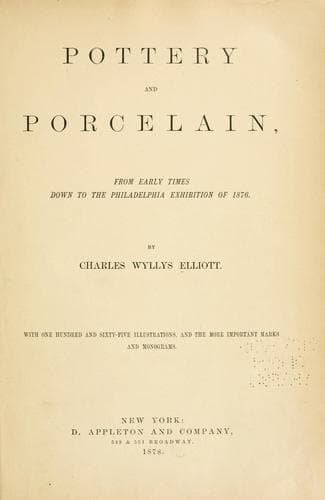
Pottery and Porcelain, from early times down to the Philadelphia exhibition of 1876Elliott, Charles Wyllys
History
Pottery and Porcelain, from early times down to the Philadelphia exhibition of 1876
Elliott, Charles Wyllys
Pottery -- History; Pottery -- Marks
Delft, Number of Fabriques.--Haarlem.--Paste.--Great
Painters.--Violins.--Tea-Services.--A Dutch Stable.--Broeck Dutch
Tiles.--England.--Queen Elizabeth.--Pepys's Diary.--Brown
Stone-ware.--The Tyg.--Lambeth Pottery.--Fulham
Pottery.--Elers.--Elizabethan Pottery.--Stoke-upon-Trent.--Josiah
Wedgwood.--Cheapness.--Queen's-ware.--Jasper-ware.--Flaxman.
--Cameos.--Basalt.--The Portland Vase.--Prices.
There was a day (about 1650) when the Dutch town of Delft had fifty
manufactories of earthen-ware, and employed in them over seven thousand
people. To-day she has but one--if even that--and the work done there
has sunk into insignificance. To those who are fond of change, of
excitement, this will be a pleasant fact to know; it goes to show that
Macaulay's prophecy, that the coming New-Zealander will sit on the piers
of London Bridge in the "good time that is coming," and moralize over
the ruins of London, may come true--pleasanter for the New Zealand
_savant_ than for the English statesman!
Haydn's "Dictionary of Dates" states that pottery was made at Delft as
early as 1310; and there are records of its importation from there into
England in the time of King Henry IV. (1399 to 1413). The great industry
was undoubtedly stimulated by the close knowledge of Japanese and
Oriental porcelains which the Dutch merchants at a very early day and
for so long a time had access to; which they brought to Holland in such
large quantities, and which by them were distributed over Europe. But
the cost of these was, of course, very considerable for those times; and
the discovery of good clays in Holland gave the Dutch every facility for
engaging in the manufacture, which they had the wit to seize and the
skill to develop; so that they were able to make earthen-ware of good
quality, with creditable ornamentation, at comparatively small prices.
The Dutch were then the great "traders" of the world. They soon sent
this pottery far and wide, into Germany, France, and England; and they
got much money for it. Holland grew rich.
Haarlem was also a centre for this industry; but it made less impression
there than at Delft, and went down sooner; so that but little is known
of it.
The _paste_ of the Delft, or at least some of it, is of a fine quality,
so that it was worked quite thin, and yet preserved sufficient strength
for use. To make this, a good deal of pains and skill was applied to it
before it went to the deft hand of the modeler.
Of course, the great production at Delft was for the uses of the table,
and its work did much to effect a revolution in the household-art of the
table. Before this production the plates and dishes of the common people
were of wood or "tre;" often only a square bit of board upon which the
meat could be laid and cut. The better-off people had plates of pewter,
and kings and princes indulged in those of silver.
Boitet, writing in 1667 of Delft, says:
Public-domain text, read in full here on John Shaqi.
Reviews
Reviews
No reviews yet
Be the first to share your thoughts on this work.
Elsewhere in the archive
Join the Discussion
Join the discussion
Sign in to leave a comment or review.
Sign InorCreate an account