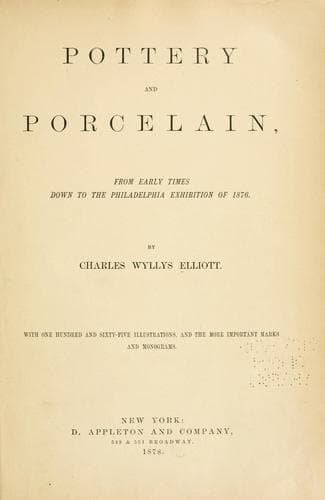
Pottery and Porcelain, from early times down to the Philadelphia exhibition of 1876Elliott, Charles Wyllys
History
Pottery and Porcelain, from early times down to the Philadelphia exhibition of 1876
Elliott, Charles Wyllys
Pottery -- History; Pottery -- Marks
Down to the times even of Queen Elizabeth (1558 to 1603) we know that
trenchers of wood, and cups and bottles of wood as well as of leather
(these were called "black jacks"), were in common use even in good
houses. As late as 1663, Pepys, in his most entertaining "Diary," says
that at the lord-mayor's feast meats were served on wooden dishes, and
were eaten off trenchers. The common dishes in Queen Elizabeth's
housekeeping were of wood; while those for the queen's table were of
silver, or possibly of pewter. These silver and pewter services
prevailed on the tables of the wealthy till some time after the
introduction of porcelain from China, and delft from Holland, which came
in in considerable quantities about 1650 and later.
The first glazed ware made in England seems to have been the brown
stone-ware, which, Chaffers says, was in use down to about 1680, and
mostly in the shape of pitchers, jugs, and bottles. It did not at first
come into use for table-dishes.
After this dishes were made of coarse and gritty clay, not at all equal
to the delft-ware, upon which a lead-glaze was used of a greenish or
dark-yellowish color. This lead or plumbiferous glaze continued in use
for a long time; but when it was _first_ used in England seems unknown.
Salt-glaze was used in Staffordshire in 1680.
One of the earliest attempts at "fancy" in English pottery is to be seen
in the drinking-cup called a "_tyg_," which has three handles, intended
for three friends; so that each could drink from his own lip in
succession. Mugs with two and four handles were also made.
At LAMBETH it is believed that some Dutch potters made earthenware
resembling delft as early as 1650. A patent was granted to some potters
by the name of Van Hamme in 1676. Various pieces of glazed pottery with
English designs remain, bearing dates from 1642 down to 1682, which it
is thought were made here.
At FULHAM stone-ware of a fine quality seems to have been made by a Mr.
Dwight as early as 1671. This, in the accounts of the day, was sometimes
called "_porcellane_." There is reason to believe that a good degree of
advance was reached here, and that the work approached that made at
Cologne, now called "Grès de Flanders." Figures and busts were also made
here, a few of which are still extant.
Two gentlemen named ELERS, who came to England with William of Orange,
were clever men, and one of them was a chemist. They discovered clay at
Bradwell, and established a pottery there, where for a time they
produced good ware from the red clay. But curious eyes were at work to
discover their processes, and one Astbury, pretending to be a
half-witted fellow, succeeded in doing it; and then their business was
ruined and broken up.
From Paul Elers descended the wife of Richard Lovel Edgeworth, whose
daughter is known as Maria Edgeworth.
Public-domain text, read in full here on John Shaqi.
Reviews
Reviews
No reviews yet
Be the first to share your thoughts on this work.
Elsewhere in the archive
Join the Discussion
Join the discussion
Sign in to leave a comment or review.
Sign InorCreate an account