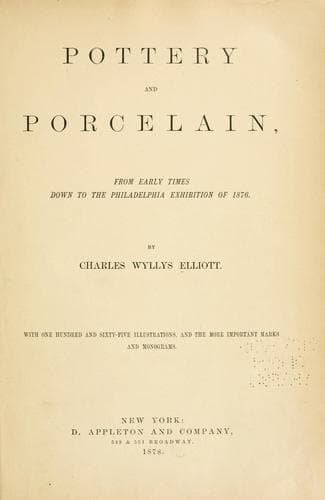
Pottery and Porcelain, from early times down to the Philadelphia exhibition of 1876Elliott, Charles Wyllys
History
Pottery and Porcelain, from early times down to the Philadelphia exhibition of 1876
Elliott, Charles Wyllys
Pottery -- History; Pottery -- Marks
A white salt-glazed stone-ware was made in Staffordshire about 1700,
which has been called "Elizabethan." This often had designs made from a
mould applied to the surface.
STOKE-UPON-TRENT, in Staffordshire, very early became a centre for
potter's work, as it is to-day; the country there for miles being a
string of villages, filled with furnaces and the houses of potters.
It is not my purpose to attempt a detailed history of the immense
pottery industries which have been developed in and about
Staffordshire--potteries which, for variety and extent, have never been
equaled, unless perhaps in China. There is, however, one potter, whose
life and work have had a distinguished influence upon the potteries of
England, to whom some space must be given; he is JOSIAH WEDGWOOD.
Born in 1730 at Burslem, he came from an ancestry of potters, and he
breathed the air of the potteries, so that he may be said to have been a
born potter. He was one of thirteen children; he grew up with the small
amount of school education then in vogue in that part of
England--especially among his class of _workers_--and was apprenticed to
a potter when he was but fourteen years old.
The English nation has in these latter days gone into a sort of frenzy
upon the subject of school education, having got the impression that
that will enable them to compete with or excel all the nations of the
world. This I believe to be a mistake. I may, I think, fairly point to
Germany, whose commissioner at the American Exhibition writes home that
the productions of Germany are marked by lack of taste, lack of
thoroughness, and lack of honesty; in other words, Germany, with the
most thorough system of common-school education, is distinguished for
the "cheap and nasty" in her work.
What was it, then, I may ask at this point, which made Josiah Wedgwood,
this unschooled boy, the most able and successful potter of England, and
perhaps of all the world? I attempt to answer it by stating my belief
_that he was not living for riches, but for excellence_. He worked all
his life to combine the useful with the beautiful more and more
perfectly; and in a surprising degree he succeeded. This was not because
of his intellectual ability, but because of his sense of _honor_.
The world has gone into a craze for intellect--not at all for _honesty_.
I mean by honesty not a sickly sort of conscientiousness, which often
hinders; but honesty of intention, showing itself in work. To illustrate
my meaning, I may say that my own experience has been that the larger
part of mankind are quite willing to "shab" a thing--to do it
poorly--provided it will sell, and give them their wages.
This, it seems to me, was just what made Wedgwood what he was; he could
not do that. All the work of his I have seen was done as well as it
could be done. I do not mean that all his designs were good or his
decorations faultless; but, as it was, it _was as well done as he could
do it_.
Public-domain text, read in full here on John Shaqi.
Reviews
Reviews
No reviews yet
Be the first to share your thoughts on this work.
Elsewhere in the archive
Join the Discussion
Join the discussion
Sign in to leave a comment or review.
Sign InorCreate an account