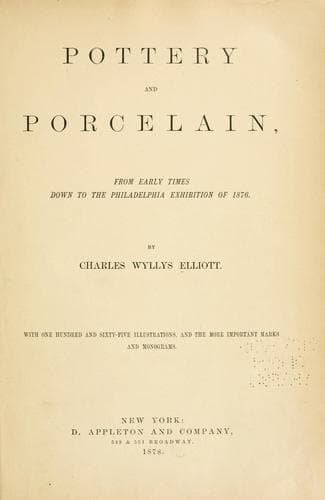
Pottery and Porcelain, from early times down to the Philadelphia exhibition of 1876Elliott, Charles Wyllys
History
Pottery and Porcelain, from early times down to the Philadelphia exhibition of 1876
Elliott, Charles Wyllys
Pottery -- History; Pottery -- Marks
It is not my purpose to give any detailed history of the life and doings
of Wedgwood. All who are enough interested will find these in his
"Life," by Llewellynn Jewitt, and in that by Miss Meteyard, both of
which are full, and are profusely illustrated. What I can do here is to
call attention to some of the most distinctive things accomplished by
this great potter.
Almost from the first, Wedgwood perceived or felt that there were good
and bad both in form and decoration; and he set to work to secure
perfection in both. While all his life he wished to make, and did make,
vases and other works for purely ornamental and artistic purposes, in
which the expression of beauty alone was sought, he had that practical
sense which taught him to apply his skill and his perception first to
the production and improvement of earthen-ware which came into the daily
uses of life. Out of this came his "queen's-ware," which soon had such a
reputation for form and quality that it went in large quantities all
over the trading world.
From this it should be known that Wedgwood made the money with which he
carried forward those investigations and experiments which at last
culminated in his finest works of fictile art.
It may as well be said here that even _his_ art-work made him no money,
although many of his pieces were reproduced. The fifty copies of the
"Portland Vase"--of which more hereafter, and which sold for fifty
guineas each--cost him more than he got for them. It is best to say
this, because some men and women think that artists are sure to become
rich. No man should attempt to be an artist with such an expectation;
for, while here and there one is caught on the wave of fashion and borne
onward to fortune, the number of these is few. No artist must expect a
_speedy_ recognition for good work.
Wedgwood would not have been Wedgwood had he not had a foundation for
his art-work in his "queen's-ware." Upon this ware a word of explanation
may be desirable. He early brought this every-day ware to great
perfection, not only of form, but of paste and glaze. It was not
painted, but was of a creamy white; and, being at such a small price, it
went into very wide use. Having sent some pieces of it as a present to
Queen Charlotte, she was induced to order a complete table-service, and
to request that it might be called "queen's-ware" thenceforth, as it is
to this day.
This service was painted in the best style then in vogue by the two
chief artists at the works, _Thomas Daniell_ and _Daniel Steele_.
One of the most remarkable dinner-services made by Wedgwood was for the
Empress Catharine II. of Russia, for her palace near St. Petersburg
called _Grenouillière_. It is thus described by Chaffers:
Public-domain text, read in full here on John Shaqi.
Reviews
Reviews
No reviews yet
Be the first to share your thoughts on this work.
Elsewhere in the archive
Join the Discussion
Join the discussion
Sign in to leave a comment or review.
Sign InorCreate an account