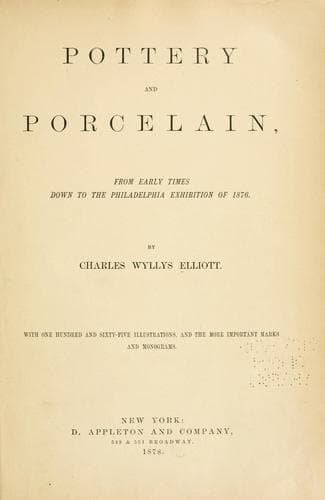
Pottery and Porcelain, from early times down to the Philadelphia exhibition of 1876Elliott, Charles Wyllys
History
Pottery and Porcelain, from early times down to the Philadelphia exhibition of 1876
Elliott, Charles Wyllys
Pottery -- History; Pottery -- Marks
"This splendid service was commenced in April, 1773, and had upward of
twelve hundred views of the seats of noblemen and gentlemen in England,
and a green frog was painted underneath each piece. The form chosen was
the royal pattern, and was made of the ordinary cream-color ware, with a
delicate saffron-tint. The views were in purple camaieu, bordered with a
gadroon pattern in Indian-ink, and round the edge a running wreath of
mauve flowers and green leaves. The two services for dinner and dessert
consisted of nine hundred and fifty-two pieces, had twelve hundred and
forty-four enamel views, which cost, on an average, twenty-one shillings
each, the borders and frogs to each about fifteen shillings more; making
the entire cost, with fifty-one pounds eight shillings and fourpence for
the cream-ware itself, a total of twenty-three hundred and fifty-nine
pounds two shillings and one penny, without calculating many extras. The
price ultimately paid by the empress was stated to be three thousand
pounds. In June, 1774, the service was sufficiently completed to exhibit
at the new rooms in Portland House, Greek Street, Soho, No. 12, where it
remained on show for nearly two months. The empress showed it to Lord
Malmesbury when he visited the Grenouillière in 1779."
I may refer here also to his partnership with Mr. Bentley as another of
the important elements of his success. Bentley was a man with capital,
and also a man with an artistic sense; and he coöperated heartily with
Wedgwood in a desire for thorough work, for excellence, and for profit.
The artistic work for which Wedgwood is so distinguished is what the
pottery collector is most interested in. This, as Wedgwood himself has
said of all good work, was not the result of chance. From the first he
used his _own_ brains and those of others. He studied whatever he could
find to improve his profession, and became something of a chemist; so
that the values of clays and silex, and the composition and use of
metallic oxides for coloring them, grew to be an art in themselves in
his hands.
The work upon which Wedgwood applied his inventions and his art may be
classified in this way:
1. Queen's-ware, for the table.
2. Terra-cotta, to represent porphyry, granite, etc.
3. Basalt, or black Egyptian.
4. White biscuit.
5. Bamboo, cream-colored biscuit.
6. Jasper, or onyx.
7. A hard porcelain biscuit, for chemists, etc.
Public-domain text, read in full here on John Shaqi.
Reviews
Reviews
No reviews yet
Be the first to share your thoughts on this work.
Elsewhere in the archive
Join the Discussion
Join the discussion
Sign in to leave a comment or review.
Sign InorCreate an account